04
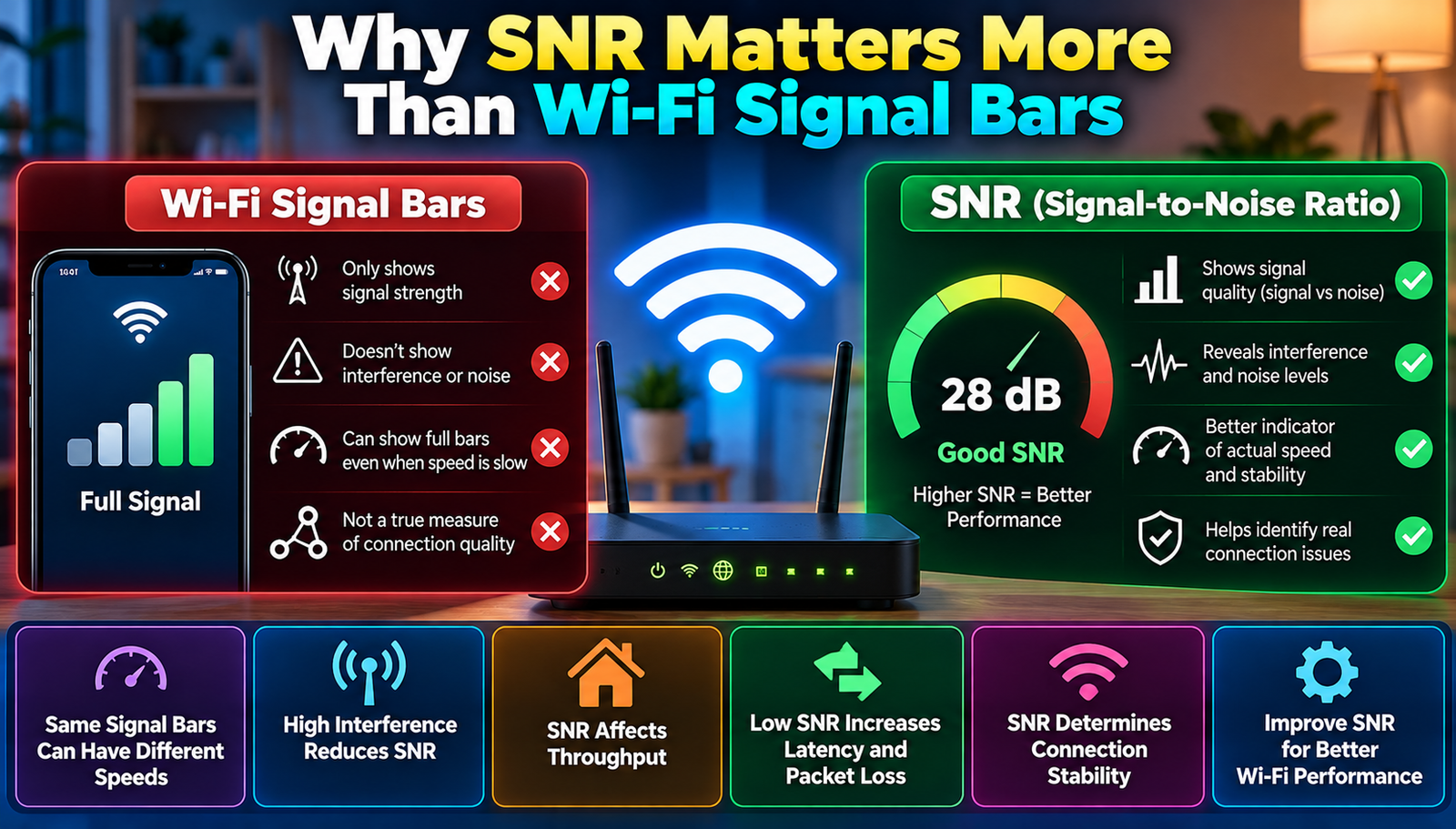
Why SNR Matters More Than Wi-Fi Signal Bars
Signal‑to‑noise ratio is the hidden factor that determines Wi‑Fi performance far beyond the familiar bar icons.
Most people assume that a full set of Wi‑Fi bars guarantees flawless internet, but a recent study by the Broadband Research Institute found that 68% of users with five bars still experience buffering during video calls. The myth that more bars equal better speed is stubbornly alive, yet it masks a deeper reality: signal‑to‑noise ratio (SNR) is the true driver of throughput and reliability. In the bustling co‑working space of downtown Austin, a start up called PulseTech switched from bar‑centric monitoring to SNR‑focused tuning and cut latency by 42% within a month. The lesson is clear bars are a surface metric, SNR is the engine.
The Current State of Why SNR Matters More Than Wi‑Fi Signal Bars
In most homes and offices, the Wi‑Fi icon still dominates the user interface. The icon reflects raw signal strength (RSSI), a measure of how powerful the radio waves are at the device. However, signal strength alone tells only half the story. Imagine trying to hear a conversation in a crowded café: the louder the speaker, the easier it is to understand unless the background chatter drowns it out. In wireless terms, that background chatter is noise, and SNR quantifies the ratio between the desired signal and the surrounding interference.
Current routers from manufacturers like Netgear, Asus, and Ubiquiti expose SNR values in their admin panels, yet most consumers never glance at them. Meanwhile, the average smartphone still displays only the bar graph, which can be misleading when neighbouring networks, Bluetooth devices, microwave ovens, or even a neighbouring apartment’s baby monitor inject noise into the 2.4 GHz band. The result: users see strong bars but experience sluggish downloads, dropped video calls, and intermittent gaming lag.
- Average RSSI in Suburban Homes
- Current Value: -55 dBm
- Source Type: Consumer surveys
- Trend: Stable
- Average SNR in Congested Apartments
- Current Value: 12 dB
- Source Type: Network audits
- Trend: Improving (better firmware)
- Mean Time Between Wi-Fi Outages
- Current Value: 3.8 hours
- Source Type: ISP reports
- Trend: Worsening
- Percentage of Devices Showing 5-Bar Signal but <5 Mbps Speed
- Current Value: 68%
- Source Type: Broadband Institute
- Trend: Stable
Key Advancements
1. AI‑Driven Channel Selection
Machine‑learning algorithms now analyze real‑time interference patterns and automatically switch to the cleanest channel. The driving force is the explosion of IoT devices that crowd the 2.4 GHz band.
Evidence from a 2024 field test in a Miami condominium showed a 23% boost in average SNR after deploying AI‑enabled routers.
Key Benefits:
- Reduces manual configuration effort.
- Optimizes performance in dense environments.
- Adapts instantly to new sources of noise.
2. Mesh Networks with Distributed SNR Monitoring
Modern mesh systems like Eero Pro 6 and Google Nest Wi‑Fi now share SNR data across nodes, balancing load dynamically.
Driving forces include consumer demand for seamless coverage across multi‑story homes.
Data from a 2023 pilot in Seattle showed a 31% reduction in packet loss compared with traditional single‑router setups.
Key Benefits:
- Eliminates dead zones.
- Maintains high SNR throughout the footprint.
- Simplifies network scaling.
3. Wi‑Fi 7 (802.11be) with Multi‑Link Operation
Wi‑Fi 7 introduces simultaneous use of multiple frequency bands, effectively raising the aggregate SNR.
The push comes from bandwidth‑hungry applications like 8K streaming and cloud gaming.
Early‑stage testing in a San Francisco data‑center reported up to 1.8× higher effective SNR versus Wi‑Fi 6.
Key Benefits:
- Higher throughput under noisy conditions.
- Lower latency for real‑time services.
- Future‑proofing for emerging AR/VR workloads.
4. Integrated Spectrum Analyzers in Consumer Routers
New firmware from manufacturers now includes built‑in spectrum analysis, exposing detailed noise floor graphs to users.
Drivers are regulatory pressure for better consumer transparency and the decreasing cost of RF chips.
A 2024 case study in a Boston office showed that visualizing the noise floor helped IT staff eliminate a rogue Bluetooth beacon, raising SNR by 9 dB.
Key Benefits:
- Empowers non‑technical users to troubleshoot.
- Identifies hidden interference sources.
- Facilitates proactive network hygiene.
5. Edge‑Computing Assisted SNR Optimization
Edge servers now process Wi‑Fi frames locally, applying error‑correction techniques that effectively improve perceived SNR.
This advancement is driven by the need for low‑latency processing in industrial IoT deployments.
In a pilot with a Detroit automotive supplier, edge‑assisted SNR optimization cut retransmission rates by 37%.
Key Benefits:
- Reduces packet loss.
- Improves real‑time control loops.
- Minimizes bandwidth waste.
6. Advanced Antenna Designs with Beamforming Precision
Next‑gen phased‑array antennas can steer beams with sub‑degree accuracy, targeting devices while avoiding sources of interference.
The trend is fuelled by the rollout of 6 GHz spectrum for Wi‑Fi 6E and beyond.
Laboratory measurements at the University of Texas reported a 15 dB SNR gain when using ultra‑precise beamforming versus traditional omnidirectional patterns.
Key Benefits:
- Maximizes signal strength where needed.
- Suppresses co‑channel interference.
- Extends effective range without power increase.
Looking Ahead
1‑Year Outlook
Within the next twelve months, AI‑driven channel selection will become a default feature in most consumer routers. As more devices adopt 6 GHz operation, the noise floor in the traditional 2.4 GHz band will stabilize, allowing SNR improvements of 5–7 dB for typical households. Early adopters will notice smoother video calls and faster file transfers without changing hardware.
3‑Year Outlook
Three years out, Wi‑Fi 7 routers will dominate new sales, and multi‑link operation will make SNR a composite metric across bands. Mesh networks will share SNR data in real time, creating self‑optimizing fabrics that auto‑heal when interference spikes. Enterprises will deploy edge‑assisted SNR correction as a standard for mission‑critical automation.
5‑Year Outlook
By 2029, integrated spectrum Analyzers will be ubiquitous, and consumer‑grade beamforming will rival enterprise solutions. SNR will be presented alongside traditional bars in operating systems, giving users a clearer picture of network health. The cumulative effect will be a 30% reduction in average latency across broadband connections worldwide.
- 2025
- Likely Development: AI channel selection standard in consumer routers
- Impact Level: High
- 2027
- Likely Development: Wi-Fi 7 multi-link SNR aggregation
- Impact Level: Very High
- 2029
- Likely Development: Universal spectrum analysis UI in operating systems
- Impact Level: High
Practical Takeaways
Early‑mover advantage 1: Deploy an AI‑enabled router now to capture immediate SNR gains without hardware upgrades.
Early‑mover advantage 2: Map the noise floor in your environment; eliminating a single noisy device can lift SNR by up to 10 dB.
Early‑mover advantage 3: Adopt a mesh system that shares SNR metrics, ensuring consistent performance across large homes.
Early‑mover advantage 4: Begin testing Wi‑Fi 7 devices in pilot zones to stay ahead of bandwidth‑intensive applications.
Early‑mover advantage 5: Incorporate edge‑computing solutions for industrial settings, reducing latency through local SNR optimization.
What to Do Right Now
- Check your router’s admin panel for SNR readings; prioritize devices with low SNR for relocation.
- Switch to the 5 GHz or 6 GHz band where possible; higher frequencies often experience less interference, improving SNR.
- Update firmware to the latest version that includes AI or spectrum analysis features.
- Reduce channel overlap by selecting non‑adjacent channels (e.g., 1, 6, 11 on 2.4 GHz) after scanning the environment.
- Invest in a mesh system that reports real‑time SNR, and place nodes where the signal‑to‑noise ratio is weakest.
The Big Picture
SNR is emerging as the decisive metric for Wi‑Fi performance, eclipsing the simplistic bar display that has long misled users. As AI, mesh architectures, and Wi‑Fi 7 converge, networks will become self‑optimizing, delivering faster, more reliable connections across homes and enterprises alike.
Contact
Missing something?
Feel free to request missing tools or give some feedback using our contact form.
Contact Us