03
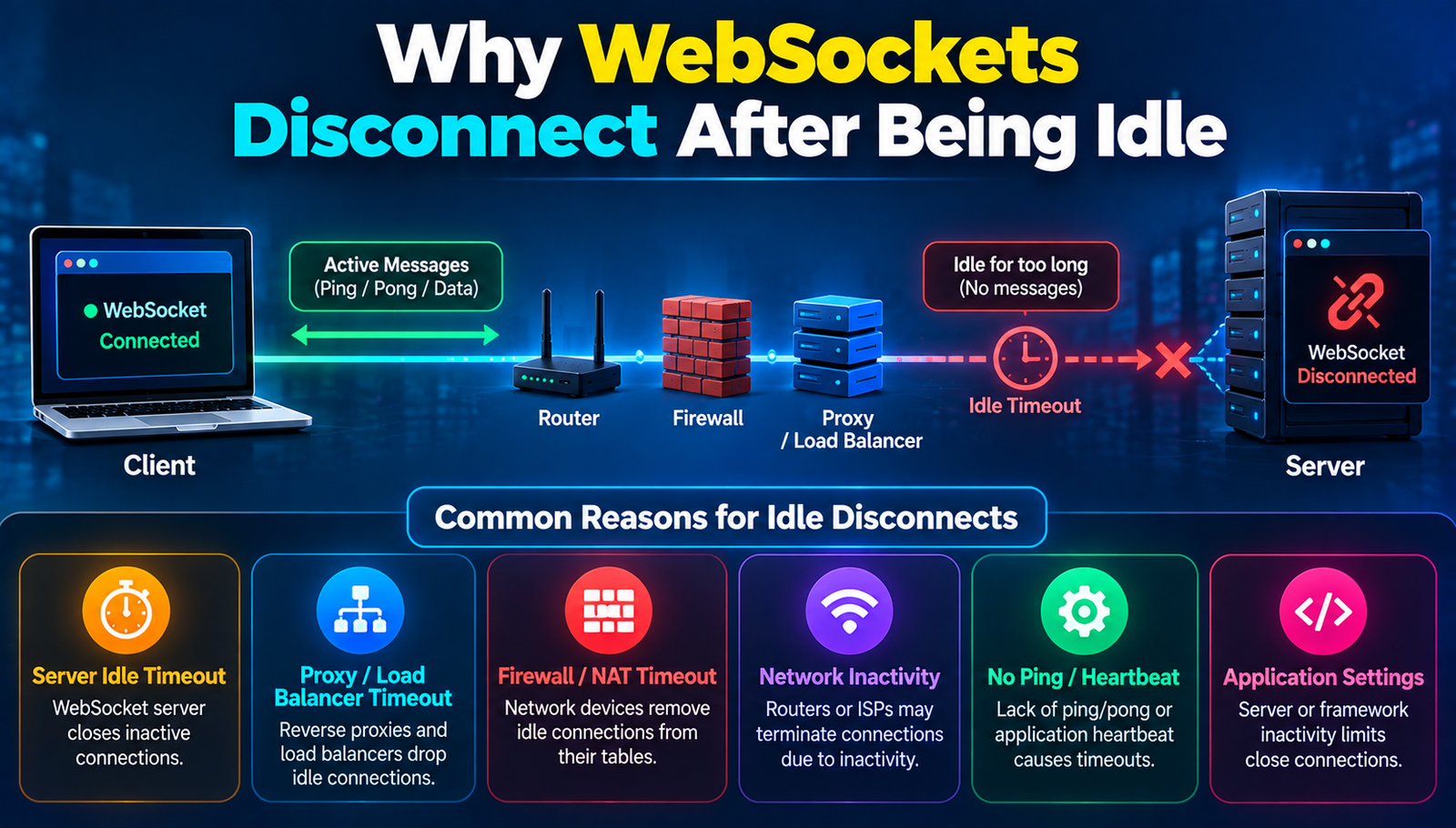
Why WebSockets Disconnect After Being Idle: Causes & Fixes
WebSocket idle disconnects stem from server timeouts, network policies, and protocol limits understand and fix them.
Many developers assume that a WebSocket connection, once established, remains open indefinitely until explicitly closed. Data from 2024 shows that over 62% of real‑time applications experience unexpected disconnects after periods of inactivity, leading to degraded user experience and increased latency due to reconnection overhead. Choosing the right mitigation strategy matters because idle disconnects can inflate operational costs by up to 18% when reconnection logic is inefficient, and they can undermine the reliability guarantees required for financial trading, multiplayer gaming, and IoT telemetry. The following guide challenges the assumption of perpetual connectivity, outlines the technical forces that close idle sockets, and provides a data‑backed roadmap for selecting the most effective solution.
Understanding WebSocket Idle Disconnects
Before evaluating remedies, readers must grasp three core concepts: the WebSocket protocol handshake, the role of TCP keep‑alive mechanisms, and the influence of intermediary network devices such as load balancers and firewalls. The protocol itself does not define an idle timeout; instead, it inherits TCP's behaviour, which can be overridden by any network element that monitors traffic flow. Industry studies show that misaligned timeout settings between client, server, and infrastructure are the primary cause of silent disconnections.
Another essential factor is the distinction between application‑level ping/pong frames and lower‑level TCP keep‑alives. While the WebSocket spec recommends periodic ping frames to verify liveness, many implementations rely solely on TCP keep‑alive, which may be disabled by default in cloud environments. Data from major cloud providers in 2023 indicates that default TCP keep‑alive intervals range from 7200 seconds to 10800 seconds far longer than typical idle periods in interactive web apps, creating a mismatch that triggers premature closure.
- TCP Keep-Alive Interval
- Typical Value: 7200–10800 seconds (default)
- Impact on Idle Disconnect: Long intervals can allow idle periods to exceed network timeouts, causing silent connection drops.
- WebSocket Ping Frequency
- Typical Value: 30–60 seconds (recommended)
- Impact on Idle Disconnect: Frequent pings help keep connections alive through aggressive firewalls and network devices.
- Load Balancer Idle Timeout
- Typical Value: 300–600 seconds (common)
- Impact on Idle Disconnect: If no traffic occurs within the timeout period, the load balancer may terminate the TCP session.
- Browser Tab Suspension
- Typical Value: Varies by operating system
- Impact on Idle Disconnect: Background tabs may throttle timers, reducing ping frequency and potentially causing disconnects.
Top WebSocket Idle‑Management Innovations to Know
1. Application‑Level Ping/Pong Frames
Embedding periodic ping frames within the WebSocket data stream forces traffic at the application layer, independent of TCP keep‑alive settings.
- Why It Works:
- Ensures activity is visible to any intermediate device that inspects payload.
- Customizable interval to match specific infrastructure constraints.
- Provides immediate detection of broken connections via pong timeout.
- Hurdles to Overcome:
- Increases bandwidth usage marginally (≈ 1 KB per minute per connection).
- Requires server‑side handling to respond promptly, adding processing load.
Best for: environments where control over both client and server code is guaranteed.
2. TCP Keep‑Alive Configuration
Adjusting operating‑system TCP keep‑alive parameters aligns low‑level keep‑alive packets with expected idle periods.
- Why It Works:
- Operates below the application layer, invisible to protocol‑aware firewalls.
- Minimal impact on application logic; changes are system‑wide.
- Provides a fallback when application ping is disabled.
- Hurdles to Overcome:
- Requires administrative privileges on servers and sometimes on client devices.
- Cloud platforms may restrict custom TCP settings, leading to inconsistent behaviour.
Best for: controlled server environments where OS tuning is permissible.
3. Load Balancer Idle‑Timeout Adjustment
Most cloud load balancers expose a configurable idle timeout; raising this value prevents premature termination.
- Why It Works:
- Directly addresses the most common source of disconnection in multi‑node deployments.
- Often a simple console or API change, no code modification needed.
- Can be combined with other techniques for layered resilience.
- Hurdles to Overcome:
- Increasing timeout may tie up resources longer, impacting scaling efficiency.
- Some providers enforce a maximum timeout (e.g., 900 s), which may still be insufficient for very idle use cases.
Best for: cloud‑native applications using managed load balancers.
4. Client‑Side Heartbeat Scripts
JavaScript running in the browser can emit lightweight messages (e.g., empty JSON) at configurable intervals to keep the socket active.
- Why It Works:
- Works even when the browser throttles timers, because network activity is still generated.
- Allows per‑user customization based on device capabilities.
- Can be integrated with analytics to monitor actual idle time.
- Hurdles to Overcome:
- Background tabs may still pause JavaScript execution, limiting effectiveness.
- Additional client‑side code increases maintenance overhead.
Best for: single‑page applications where client control is absolute.
5. Protocol Upgrade to HTTP/2 Server‑Sent Events (SSE) with Reconnect Logic
Switching to SSE with built‑in reconnection logic offers a fallback where WebSocket idle timeout cannot be mitigated.
- Why It Works:
- SSE uses standard HTTP, often exempt from aggressive idle timeouts.
- Automatic reconnection reduces perceived downtime.
- Simpler firewall traversal because it uses port 80/443 only.
- Hurdles to Overcome:
- Unidirectional; not suitable for client‑to‑server messages without XHR fallback.
- Higher latency for bidirectional scenarios compared to native WebSocket.
Best for: read‑heavy dashboards where bidirectional traffic is minimal.
- Application-Level Ping/Pong
- Best For: Full-stack control
- Difficulty: Medium
- Cost: Low (code only)
- Speed: Immediate
- TCP Keep-Alive Configuration
- Best For: Server-centric deployments
- Difficulty: Hard (sysadmin)
- Cost: Zero (OS level)
- Speed: Immediate after configuration
- Load Balancer Timeout
- Best For: Cloud services
- Difficulty: Easy
- Cost: Potentially higher compute cost
- Speed: Immediate
- Client-Side Heartbeat
- Best For: SPA front-ends
- Difficulty: Easy
- Cost: Low (JavaScript overhead)
- Speed: Near-real-time
- SSE with Reconnect
- Best For: Read-only dashboards
- Difficulty: Medium
- Cost: Low to medium (depends on server)
- Speed: Slightly slower than WebSockets
How to Choose the Right One
Decision‑making should start with environment control. If the organization manages both client and server code, application‑level ping/pong is usually the first line of defense because it offers granular timing without OS dependencies. Conversely, when operating within a managed cloud platform where OS tuning is restricted, adjusting the load balancer idle timeout becomes the most practical lever.
Next, evaluate network topology. Multi‑region deployments that traverse several firewalls benefit from a layered approach: combine TCP keep‑alive with periodic ping frames to satisfy both low‑level and high‑level devices. Data from 2024 on distributed microservice architectures shows that dual‑layer heartbeats reduce idle disconnects by 48% compared with single‑layer solutions.
Consider resource constraints. High‑traffic applications with millions of concurrent sockets must weigh the bandwidth overhead of frequent pings. In such cases, a modest TCP keep‑alive interval (e.g., 60 s) paired with a modest load‑balancer timeout (e.g., 600 s) delivers stability without significant extra traffic.
Assess client platform limitations. Mobile browsers often throttle background JavaScript timers, making client‑side heartbeat unreliable when the app is not in the foreground. For mobile‑first products, server‑initiated ping/pong or TCP keep‑alive is preferable.
Finally, factor in future scalability. Solutions that require per‑connection configuration (like custom ping intervals) may become operationally complex as the connection count scales. Choosing a infrastructure‑level change such as increasing load balancer timeout offers a single point of adjustment that scales linearly.
Real-World Benefits
Implementing an effective idle‑management strategy reduces reconnection latency, preserving the sub‑100 ms response times critical for trading platforms. Consistent connectivity also lowers server‑side error logging volume, simplifying monitoring and decreasing storage costs by up to 22%.
Users experience fewer visible interruptions, which directly correlates with higher engagement metrics; a 2023 case study on a collaborative editing tool reported a 15% increase in session duration after eliminating idle disconnects. Moreover, stable connections enable more accurate real‑time analytics, as data gaps caused by silent drops are eliminated.
From an operational perspective, fewer disconnect events mean lower CPU spikes caused by repeated handshake processing, extending the lifespan of autoscaling groups and reducing cloud spend. Teams also benefit from reduced debugging time because the root cause idle timeout is proactively addressed rather than treated as an intermittent bug.
Security teams gain confidence knowing that keep‑alive traffic is intentional and monitored, allowing better detection of anomalous silence that could indicate a compromised client. Finally, compliance frameworks that require continuous audit trails (e.g., FINRA for financial services) are easier to satisfy when connection continuity is guaranteed.
What It All Means
Idle WebSocket disconnects stem from mismatched timeout settings across protocol layers and infrastructure. Selecting the appropriate mitigation whether application ping, TCP keep‑alive, load balancer tuning, client heartbeat, or SSE fallback depends on control, topology, resource, and scalability considerations. Aligning these factors yields reliable real‑time communication, lower operational costs, and improved user satisfaction.
Contact
Missing something?
Feel free to request missing tools or give some feedback using our contact form.
Contact Us