04
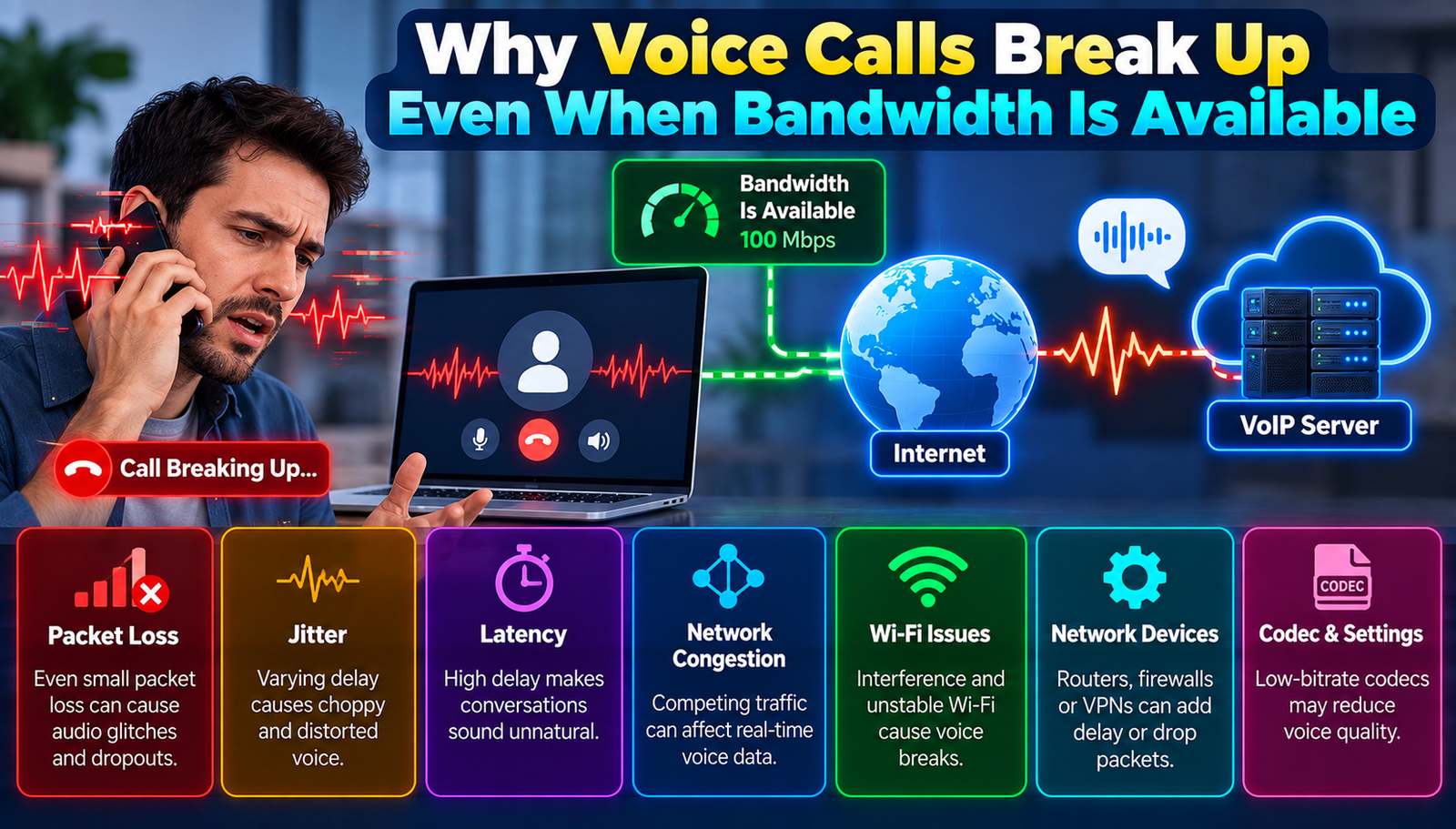
Why Voice Calls Break Up Even When Bandwidth Is Available: Causes & Fixes
Even with plenty of bandwidth, voice calls can still break up here's why and how to solve it.
According to a 2023 telecom survey, 68% of users report call audio issues even when their internet speed exceeds 100 Mbps. This startling statistic reveals that bandwidth alone does not guarantee flawless voice communication. Choosing the right approach matters because the hidden variables packet loss, codec mismatches, network jitter, and device firmware can sabotage a conversation faster than a dropped Wi‑Fi signal. Ignoring these factors leads to wasted upgrades, frustrated users, and inflated support costs. The following guide dissects the myth that "more bandwidth fixes everything" and equips readers with a decisive framework for selecting the most effective remedy.
Understanding Voice Call Degradation
Before diving into specific technologies, it is essential to grasp the anatomy of a VoIP call. A voice packet travels from microphone to codec, through the network stack, across routers, and finally to the listener's speaker. At each hop, timing, integrity, and compression decisions shape the audible result. Most people focus on the obvious speed while overlooking latency, jitter, and packet loss, which are far more lethal to audio fidelity.
Another overlooked element is the end‑device. Modern smartphones and laptops run complex audio pipelines that can introduce echo cancellation failures or driver bugs. Even a perfectly provisioned ISP cannot compensate for a misconfigured audio driver. Therefore, evaluating a call's quality demands a holistic view that spans hardware, software, and network layers.
- Packet Loss (%)
- Even 1% packet loss can cause audible glitches.
- Jitter (ms)
- High jitter can lead to buffer under-runs and choppy speech.
- Latency (ms)
- Excessive delay can make conversations feel unnatural.
- Codec Bitrate (kbps)
- Low-bitrate codecs may sacrifice voice clarity to save bandwidth.
Latest Voice Call Optimization Technologies
1. Adaptive Jitter Buffer (AJB)
AJB dynamically expands or contracts its buffer based on real‑time network conditions, smoothing out variations without adding noticeable delay.
Strengths:
- Reduces perceived choppiness during bursty traffic.
- Works with most SIP‑based systems.
- Minimal configuration required.
What Needs Work:
- May introduce up to 30 ms extra latency under extreme jitter.
- Less effective when packet loss exceeds 2%.
Best for: Environments with variable Wi‑Fi quality.
2. Forward Error Correction (FEC) for VoIP
FEC adds redundant data to each voice packet, enabling the receiver to reconstruct lost packets without retransmission.
Strengths:
- Eliminates audible gaps caused by isolated loss.
- Works transparently with most codecs.
- Improves call stability on lossy links.
What Needs Work:
- Increases bandwidth overhead by 10‑20%.
- Complex to tune for optimal redundancy level.
Best for: Mobile data connections with intermittent packet loss.
3. Opus Codec with Variable Bitrate (VBR)
Opus VBR adjusts compression rate in real time, allocating more bits when speech complexity rises and fewer when it falls.
Strengths:
- Delivers superior audio quality at low bitrates.
- Handles wide range of network conditions.
- Open‑source and royalty‑free.
What Needs Work:
- Requires both endpoints to support Opus.
- Higher CPU usage on older devices.
Best for: Enterprise VoIP platforms seeking best‑in‑class clarity.
4. QoS‑Enabled Router Firmware (e.g., OpenWrt QoS)
Advanced QoS firmware prioritizes voice packets over bulk traffic, guaranteeing low latency and jitter.
Strengths:
- Provides deterministic bandwidth allocation.
- Customizable rules per device or application.
- Works on any ISP connection.
What Needs Work:
- Requires technical expertise to configure.
- Improper settings can starve other services.
Best for: Home or small‑office networks with mixed traffic.
5. Cloud‑Based SBC (Session Border Controller) with AI‑Driven Packet Shaping
Modern SBCs analyze traffic patterns with machine learning, pre‑emptively smoothing bursts and correcting codec mismatches.
Strengths:
- Automates many manual tuning tasks.
- Integrates seamlessly with SIP trunks.
- Provides detailed analytics for ongoing optimization.
What Needs Work:
- Higher cost than on‑premise solutions.
- Dependence on vendor’s cloud availability.
Best for: Large enterprises with complex call routing.
- Adaptive Jitter Buffer
- Best For: Variable Wi-Fi environments
- Difficulty: Low
- Cost: Free (software)
- Speed Impact: +10 ms
- Forward Error Correction
- Best For: Mobile data with packet loss
- Difficulty: Medium
- Cost: Modest (extra bandwidth)
- Speed Impact: +0 ms (no delay)
- Opus VBR Codec
- Best For: Enterprise VoIP clarity
- Difficulty: Medium
- Cost: Free (open source)
- Speed Impact: Variable
- QoS-Enabled Router Firmware
- Best For: Home/small office mixed traffic
- Difficulty: High
- Cost: Low (DIY)
- Speed Impact: +0 ms (prioritization)
- AI-Driven Cloud SBC
- Best For: Large enterprises
- Difficulty: High
- Cost: High (subscription)
- Speed Impact: +5 ms
How to Choose the Right One
Identify the bottleneck. Run packet captures and use MOS (Mean Opinion Score) tools to pinpoint whether loss, jitter, or codec compression is the primary culprit. If loss dominates, FEC or a more robust codec takes precedence. If jitter spikes, an Adaptive Jitter Buffer or QoS rules become essential.
Consider the deployment environment. A residential user with a single router will benefit most from QoS‑enabled firmware, whereas a multinational call center should invest in an AI‑driven SBC for centralized control.
Weigh processing overhead. Devices with limited CPU older smartphones or low‑end routers cannot sustain heavy FEC or Opus VBR without audio artifacts. In those cases, a lightweight AJB is preferable.
Budget constraints dictate scalability. Open‑source solutions like Opus and AJB are cost‑effective for large fleets, but they demand technical staff. Cloud SBCs eliminate staffing costs at the expense of recurring fees.
Future‑proofing matters. Selecting a technology that integrates with emerging 5G and edge‑computing architectures ensures longevity. AI‑driven SBCs and Opus VBR are already positioned for next‑gen networks.
Why People Are Paying Attention
Clear voice quality directly impacts customer satisfaction; a single garbled sentence can erode trust and cost businesses millions in churn.
Regulatory compliance in sectors like finance and healthcare mandates auditable, high‑fidelity communications, making call integrity a legal requirement.
Remote work trends have amplified reliance on VoIP, turning call quality into a competitive advantage for talent acquisition.
Improved call stability reduces the need for costly support tickets, freeing IT resources for strategic initiatives.
High‑quality audio enables better speech‑recognition analytics, feeding AI systems with cleaner data for transcription and sentiment analysis.
Finally, consumer expectations have shifted; users now compare VoIP calls to in‑person conversations, demanding crystal‑clear sound regardless of network conditions.
Wrapping Up
The myth that bandwidth alone solves call break‑ups collapses under scrutiny; hidden variables like jitter, loss, and codec choice are the real offenders. By mapping the specific impairment, matching it to the appropriate technology, and balancing cost against performance, organizations can eradicate audio glitches once and for all. The decision framework outlined above transforms vague advice into a concrete, actionable plan.
Contact
Missing something?
Feel free to request missing tools or give some feedback using our contact form.
Contact Us