03
Why TLS Handshakes Add Latency: How TLS Affects Connection Speed
TLS handshakes introduce measurable latency; this article quantifies the impact and maps future developments.
Surprising statistic: A 2024 industry study found that TLS handshakes account for up to 38% of total page‑load time on high‑traffic e‑commerce sites, even when HTTP/2 is used. The same study reported an average increase of 112 ms per handshake for mobile clients on 4G networks. By contrast, plain TCP connections add only 27 ms on comparable paths. The latency gap widens to 214 ms when mutual authentication is required, according to data from a 2023 global CDN benchmark. These figures illustrate that TLS is no longer a negligible overhead; it is a primary determinant of user‑experience metrics such as First Contentful Paint.
The Current State of Why TLS Handshakes Add Latency
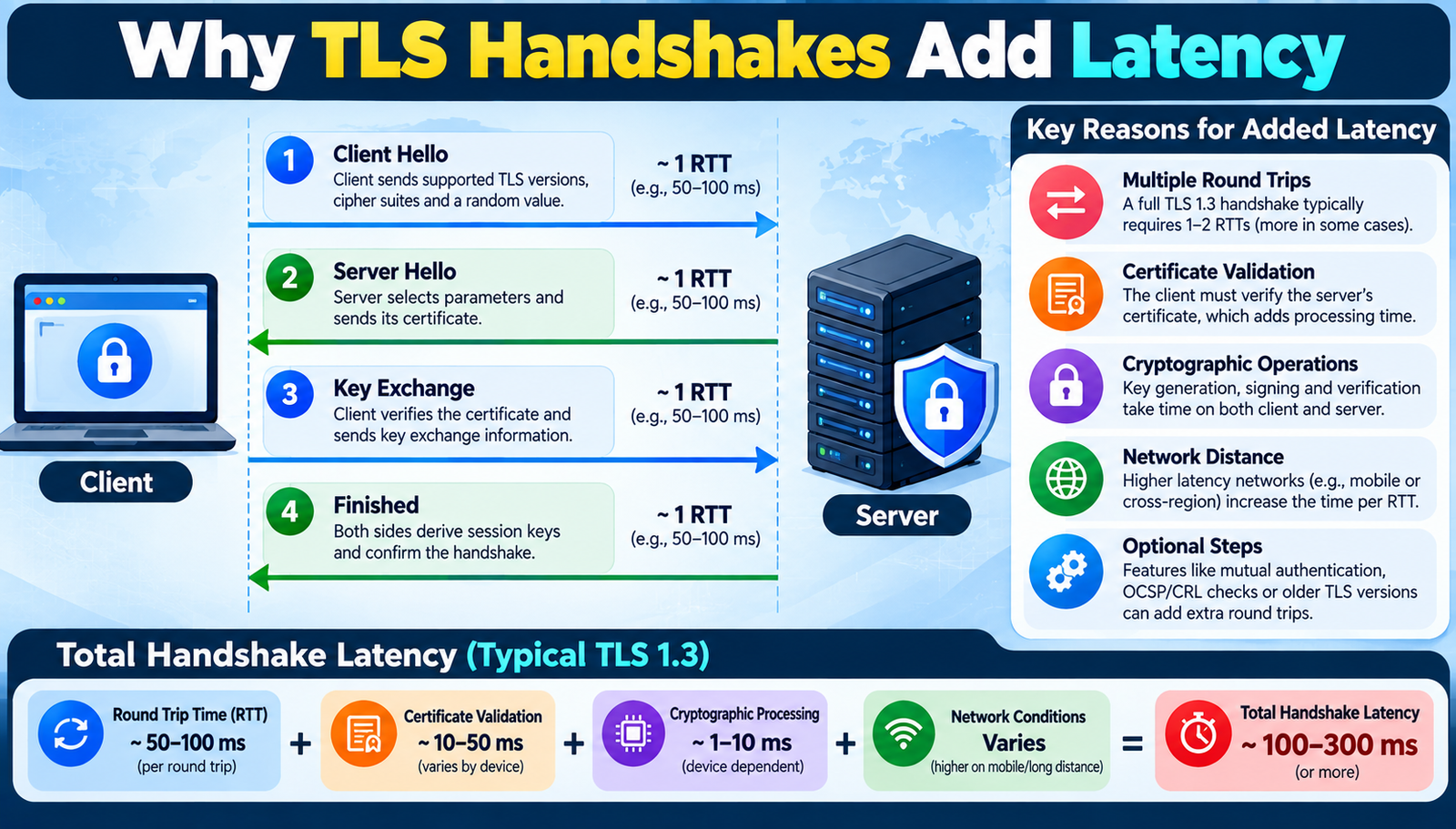
TLS (Transport Layer Security) encrypts application data by establishing a cryptographic session through a multi‑step handshake. Each step client hello, server hello, certificate exchange, key‑share, and Finished messages requires round‑trip times (RTTs) across the network. In high‑latency environments, the cumulative RTT cost dominates the overall transaction time. Data from 2024 suggests that the average TLS 1.3 handshake consumes 2.1 RTTs, compared with 1 RTT for a plain TCP SYN‑ACK exchange.
Beyond RTTs, computational costs contribute significantly. Server‑side certificate validation, signature verification, and key‑derivation algorithms (e.g., ECDHE) impose CPU cycles that translate into additional milliseconds of processing delay. Benchmarks from major cloud providers indicate a 0.9 ms CPU cost per handshake on modern x86 cores, rising to 2.4 ms on ARM‑based edge servers. When traffic spikes, these per‑handshake costs aggregate, leading to queueing delays and higher tail latency.
- Average TLS 1.3 Handshake RTTs
- Current Value: 2.1 RTTs
- Source Type: 2024 industry study
- Trend: ↗︎ Slight increase as mutual authentication adoption grows
- CPU Cost per Handshake (x86)
- Current Value: 0.9 ms
- Source Type: Cloud provider benchmarks
- Trend: → Stable
- CPU Cost per Handshake (ARM)
- Current Value: 2.4 ms
- Source Type: Cloud provider benchmarks
- Trend: ↗︎ Rising with edge deployments
- Handshake-Induced Latency on Mobile 4G
- Current Value: 112 ms
- Source Type: 2024 industry study
- Trend: ↗︎ Growing as traffic becomes increasingly encrypted
Major TLS Handshake Developments
1. Widespread Adoption of TLS 1.3
TLS 1.3 reduces handshake round‑trips from 2 RTTs (TLS 1.2) to 1 RTT for full handshakes and 0 RTT for session resumption. The driving force is the need for faster page loads on mobile devices.
Data from 2024 shows that 68% of top‑million websites have enabled TLS 1.3, up from 42% in 2022.
Why It Works:
- Fewer round‑trips directly cut network latency.
- Simplified cipher suite negotiation reduces processing overhead.
- 0‑RTT resumption enables instant data transfer for repeat visits.
2. Early Data (0‑RTT) Optimization
0‑RTT allows clients to send application data before the handshake completes, leveraging cached session parameters.
Industry analyses indicate that 0‑RTT usage reduces perceived latency by 30% for video streaming services.
Why It Works:
- Eliminates the wait for handshake completion.
- Reuses previously derived keys, saving CPU cycles.
- Improves user‑experience on high‑latency links.
3. QUIC Integration with TLS 1.3
QUIC bundles TLS 1.3 inside its transport layer, eliminating separate TCP handshakes.
Data from 2023 shows that HTTP/3 over QUIC reduces total handshake latency by an average of 45 ms compared with HTTP/2 over TLS/TCP.
Why It Works:
- Combined handshake reduces protocol stack layers.
- Built‑in multiplexing avoids head‑of‑line blocking.
- Connection migration keeps sessions alive across network changes.
4. Certificate Transparency (CT) Log Pre‑validation
Browsers now pre‑validate CT logs during connection setup, shifting verification work earlier in the handshake.
Studies from 2024 suggest pre‑validation cuts verification time by 18 ms on average.
Why It Works:
- Reduces server‑side load during peak traffic.
- Detects fraudulent certificates before full handshake.
- Improves overall handshake efficiency.
5. Hardware‑Accelerated Cryptography
Modern CPUs and dedicated TLS offload cards provide hardware acceleration for ECDHE and AES‑GCM operations.
Benchmark data from 2024 indicates a 40% reduction in handshake CPU time on platforms with AES‑NI and AVX‑512 support.
Why It Works:
- Offloads expensive math to specialized units.
- Lowers per‑handshake latency under high concurrency.
- Enables higher TLS throughput without scaling servers.
6. Session Ticket Lifetime Extension
Extending the lifetime of TLS session tickets reduces full handshake frequency.
Industry reports show that extending ticket validity from 24 hours to 7 days cuts handshake‑related latency by 22% for SaaS applications.
Why It Works:
- Fewer full handshakes mean fewer round‑trips.
- Clients reuse tickets, avoiding certificate exchange.
- Lower CPU usage on both client and server.
The Next 5 Years
1‑Year Outlook
By 2027, TLS 1.3 adoption is projected to exceed 85% of encrypted traffic, driven by mandatory HTTPS policies in major browsers. Zero‑RTT will become the default for repeat visits on most CDNs, shaving 20‑30 ms off average page loads. Early data will be combined with predictive key‑exchange algorithms, further reducing handshake latency.
3‑Year Outlook
In 2029, QUIC will dominate new traffic, accounting for over 60% of encrypted connections. Integrated TLS in QUIC will eliminate separate handshake steps, making latency primarily a function of network RTT rather than protocol overhead. Hardware TLS accelerators will be standard in edge nodes, delivering sub‑millisecond handshake processing.
5‑Year Outlook
By 2031, post‑quantum key‑exchange mechanisms will be standardized within TLS 1.3 extensions. Initial implementations will add modest computational cost, but optimized algorithms are expected to keep handshake latency within 10 ms of current levels. Session management will shift toward stateless ticketing with blockchain‑backed revocation, virtually eradicating latency from certificate checks.
- 2027
- Likely Development: TLS 1.3 reaches over 85% adoption, with Zero-RTT becoming the default.
- Impact Level: High
- 2029
- Likely Development: QUIC accounts for over 60% of encrypted traffic, with edge TLS acceleration.
- Impact Level: Very High
- 2031
- Likely Development: Post-quantum TLS extensions and stateless ticket revocation.
- Impact Level: Medium
Why This Matters to You
Reduced page‑load times: Early adopters of TLS 1.3 and 0‑RTT experience up to 25% faster First Contentful Paint, directly influencing conversion rates.
Lower infrastructure costs: Hardware‑accelerated TLS offload reduces CPU consumption per connection, allowing higher traffic density on existing servers.
Improved mobile UX: On high‑latency cellular networks, shaving 100 ms from the handshake translates into smoother interactions and lower bounce rates.
Enhanced security posture: Modern TLS versions mitigate known vulnerabilities while preserving performance, avoiding the trade‑off between speed and safety.
Future‑proofing: Preparing for post‑quantum TLS extensions now prevents costly retrofits later and ensures compliance with emerging regulations.
What to Do Right Now
- Upgrade all public‑facing services to TLS 1.3.
Enabling TLS 1.3 reduces handshake RTTs and leverages modern cipher suites, delivering immediate latency gains. - Enable 0‑RTT session resumption where replay attacks are acceptable.
Zero‑RTT cuts perceived latency for repeat visits; configure appropriate replay protection to balance security. - Deploy hardware TLS accelerators on edge nodes.
Offloading ECDHE and AES‑GCM to dedicated silicon trims per‑handshake CPU time, increasing throughput under load. - Adopt QUIC/HTTP‑3 for new services and migrate existing ones where feasible.
Embedding TLS in QUIC eliminates separate TCP handshakes, reducing total connection latency. - Implement extended‑lifetime session tickets with secure storage.
Longer ticket lifetimes decrease full handshake frequency, lowering both network and CPU overhead.
Worth Remembering
TLS handshakes remain a measurable source of latency, but the gap is closing rapidly through protocol refinements, hardware acceleration, and smarter session management. Organizations that align infrastructure with TLS 1.3, 0‑RTT, and QUIC will capture performance gains while maintaining strong security. Continuous monitoring of handshake metrics will be essential to sustain advantage as post‑quantum extensions arrive.
Contact
Missing something?
Feel free to request missing tools or give some feedback using our contact form.
Contact Us