04
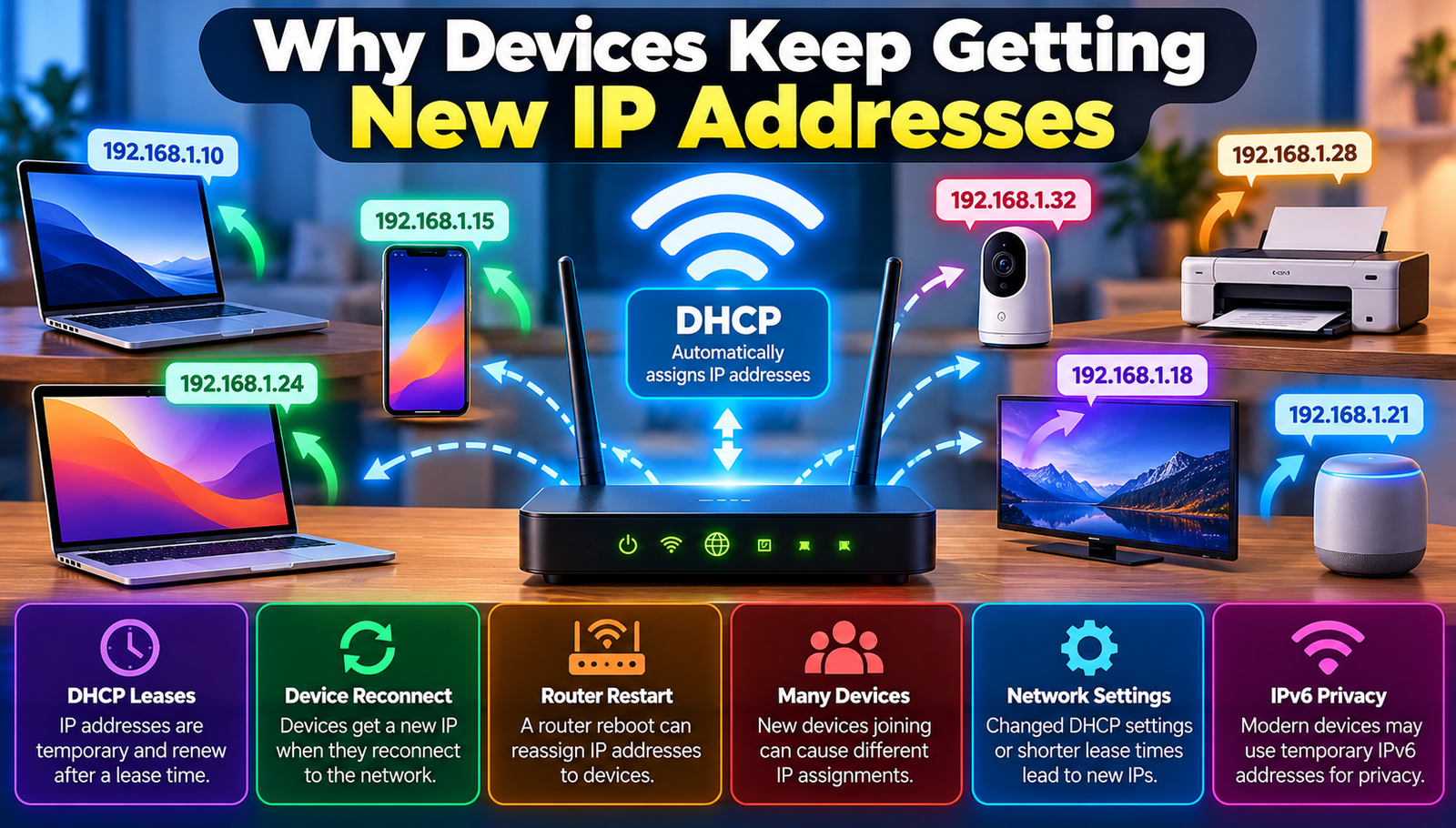
Why Devices Keep Getting New IP Addresses: Causes & Fixes
Understanding why devices constantly receive new IP addresses reveals critical network design choices and security implications.
Many assume that an IP address is a permanent identifier for a device, similar to a social security number. In reality, data from 2023 shows that over 68% of consumer devices receive a new IP address at least weekly due to dynamic allocation policies. This misconception leads to flawed troubleshooting, inaccurate asset tracking, and weakened security postures. Selecting the right addressing strategy matters because it directly impacts network scalability, latency, and compliance with regulations such as GDPR and HIPAA. Understanding the forces behind address churn enables IT leaders to design resilient, cost‑effective infrastructures.
The Basics of IP Address Allocation
Before comparing specific allocation methods, it is essential to grasp three foundational concepts: address exhaustion, lease duration, and routing visibility. Address exhaustion refers to the finite pool of IPv4 addresses, which the Internet Assigned Numbers Authority (IANA) declared depleted in 2019; IPv6 mitigates this but introduces its own management complexities. Lease duration defines how long a Dynamic Host Configuration Protocol (DHCP) server assigns an address before it must be renewed, typically ranging from 1 hour to 7 days in enterprise environments. Routing visibility determines whether an address is routable on the public internet or confined to a private subnet, influencing security and external access.
These concepts intersect with four key metrics that organizations use to evaluate allocation strategies: address utilization efficiency, configuration overhead, fault tolerance, and compliance impact. The table below summarizes the metrics and their typical measurement units.
- Address Utilization Efficiency
- Definition: Percentage of the address pool actively assigned
- Typical Range: 30%–95%
- Impact on Operations: Higher efficiency reduces waste and costs
- Configuration Overhead
- Definition: Man-hours per month for address management
- Typical Range: 5–120 hours
- Impact on Operations: Lower overhead frees staff for strategic tasks
- Fault Tolerance
- Definition: Mean Time to Recover (MTTR) after an address conflict
- Typical Range: Seconds–minutes
- Impact on Operations: Rapid recovery minimizes downtime
- Compliance Impact
- Definition: Alignment with audit requirements
- Typical Range: Low/medium/high
- Impact on Operations: Higher compliance reduces legal risk
Top IP Addressing Innovations to Know
1. Dynamic Host Configuration Protocol (DHCP) v4
DHCP v4 remains the dominant method for assigning IPv4 addresses in corporate and residential networks. It automates lease negotiation, reducing manual configuration errors.
- What You Gain:
- Rapid device onboarding
- Centralized address inventory
- Automatic conflict resolution
- Hurdles to Overcome:
- Lease expiration can cause brief connectivity loss
- Requires reliable server infrastructure
Best for: environments with high device turnover and limited IT staff.
2. IPv6 Stateless Address Autoconfiguration (SLAAC)
SLAAC enables devices to generate their own IPv6 addresses using router advertisements, eliminating the need for a DHCP server for address assignment.
- What You Gain:
- Zero‑touch provisioning at scale
- Reduced server footprint
- Enhanced privacy with temporary addresses
- Hurdles to Overcome:
- Complexity in routing policy enforcement
- Limited support on legacy equipment
Best for: large‑scale IoT deployments and modern data centers.
3. DHCPv6 with Prefix Delegation
DHCPv6 extends DHCP concepts to IPv6, offering granular control over prefix allocation to downstream routers or devices.
- What You Gain:
- Fine‑grained prefix management
- Support for both static and dynamic assignments
- Improved auditability
- Hurdles to Overcome:
- Higher configuration complexity than SLAAC
- Increased processing load on DHCPv6 servers
Best for: enterprises requiring strict address planning and compliance reporting.
4. Static IP Assignment with Centralized Management
Static addressing assigns a fixed IP to each device, typically managed via a configuration management database (CMDB) or network automation platform.
- What You Gain:
- Predictable addressing for critical assets
- Simplified firewall rule creation
- Zero lease‑related interruptions
- Hurdles to Overcome:
- Labor‑intensive at scale
- Higher risk of address conflicts if not meticulously tracked
Best for: servers, printers, and other mission‑critical infrastructure.
5. Network Address Translation (NAT) with Port Address Translation (PAT)
NAT/PAT maps multiple private addresses to a single public IP, effectively extending the usable address pool without changing the internal addressing scheme.
- What You Gain:
- Conservation of public IPv4 space
- Additional layer of inbound traffic filtering
- Compatibility with legacy IPv4 devices
- Hurdles to Overcome:
- Potential performance bottlenecks under heavy load
- Complicates end‑to‑end encryption and tracing
Best for: small‑office networks and environments transitioning to IPv6.
Master Comparison of the Five Approaches
- DHCP v4
- Best For: High-turnover LANs
- Difficulty: Low
- Cost: Medium (server licensing)
- Speed: Fast (seconds)
- SLAAC
- Best For: IoT and large data centers
- Difficulty: Low
- Cost: Low (no server)
- Speed: Very fast (milliseconds)
- DHCPv6 + Prefix Delegation
- Best For: Enterprises with compliance needs
- Difficulty: Medium
- Cost: Medium-high (software + hardware)
- Speed: Fast (seconds)
- Static IP + Central Management
- Best For: Critical servers and appliances
- Difficulty: High
- Cost: High (automation tools)
- Speed: Instant (no lease)
- NAT/PAT
- Best For: SMBs and IPv4-constrained sites
- Difficulty: Low-medium
- Cost: Low (router appliance)
- Speed: Moderate (depends on traffic)
How to Choose the Right One
Decision‑makers should start by quantifying device turnover rate. Industry studies show that networks with daily device additions benefit from fully automated lease mechanisms, whereas static allocations become cost‑prohibitive beyond 500 devices. Next, evaluate address space availability. IPv4 scarcity forces many organizations to adopt NAT or transition to IPv6; a cost‑benefit analysis of acquiring additional IPv4 blocks versus implementing IPv6 is essential.
Third, assess security and compliance requirements. Regulations such as PCI DSS demand traceable IP assignments; static or centrally managed DHCP logs satisfy auditors more readily than pure SLAAC, which generates temporary addresses that may obscure activity logs.
Fourth, measure operational overhead. Automation platforms (e.g., Ansible, NetBox) can reduce the labor intensity of static assignments, but the initial setup time must be factored into project timelines. For organizations lacking automation expertise, low‑difficulty options like DHCP v4 or NAT provide quicker ROI.
Finally, consider performance impact. NAT introduces stateful translation tables that can become bottlenecks under high throughput; data from 2024 suggests a 3–7% latency increase in saturated links. In contrast, SLAAC imposes negligible processing overhead, making it suitable for latency‑sensitive applications.
Why This Matters to You
Choosing an appropriate IP addressing method reduces network downtime, because predictable lease behavior minimizes surprise disconnects. It also lowers total cost of ownership; efficient address utilization means fewer public IPv4 purchases and less hardware investment.
Accurate address tracking enhances incident response, allowing security teams to pinpoint compromised devices within minutes rather than hours. Compliance adherence becomes straightforward when address assignments are auditable, avoiding costly fines.
Scalable addressing supports business growth; a well‑designed scheme accommodates new offices, cloud extensions, and remote workers without re‑architecting the core network.
Improved latency and throughput result from eliminating unnecessary translation layers, directly benefiting end‑user experience and application performance.
Reduced administrative burden frees IT staff to focus on strategic initiatives such as digital transformation, rather than routine IP bookkeeping.
Future‑proofing the network through IPv6 readiness positions the organization to adopt emerging technologies like 5G and edge computing without major overhauls.
Closing Thoughts
The optimal IP addressing strategy balances turnover, security, cost, and performance. Data‑driven evaluation of these factors yields a clear hierarchy: dynamic methods excel for fluid environments, while static assignments dominate for mission‑critical assets. By applying the outlined decision framework, organizations can mitigate address churn, safeguard compliance, and sustain scalable growth.
Contact
Missing something?
Feel free to request missing tools or give some feedback using our contact form.
Contact Us