02
IP Address Geolocation: How It Works, Accuracy & Uses
Uncover the real power of IP address geolocation beyond the hype and learn actionable strategies for today and tomorrow.
Imagine a digital marketer launching a hyper‑targeted ad campaign, confident that every visitor will see region‑specific offers based on their IP address. Suddenly, the analytics dashboard shows a spike in traffic from a country that the business never intended to target, and the conversion rates plummet. The culprit? A flawed assumption that IP geolocation is a silver bullet for location‑based personalization. This scenario repeats across e‑commerce, cybersecurity, and content delivery networks, exposing a dangerous overreliance on a technology that is often misunderstood.
A Closer Look at IP Address Geolocation
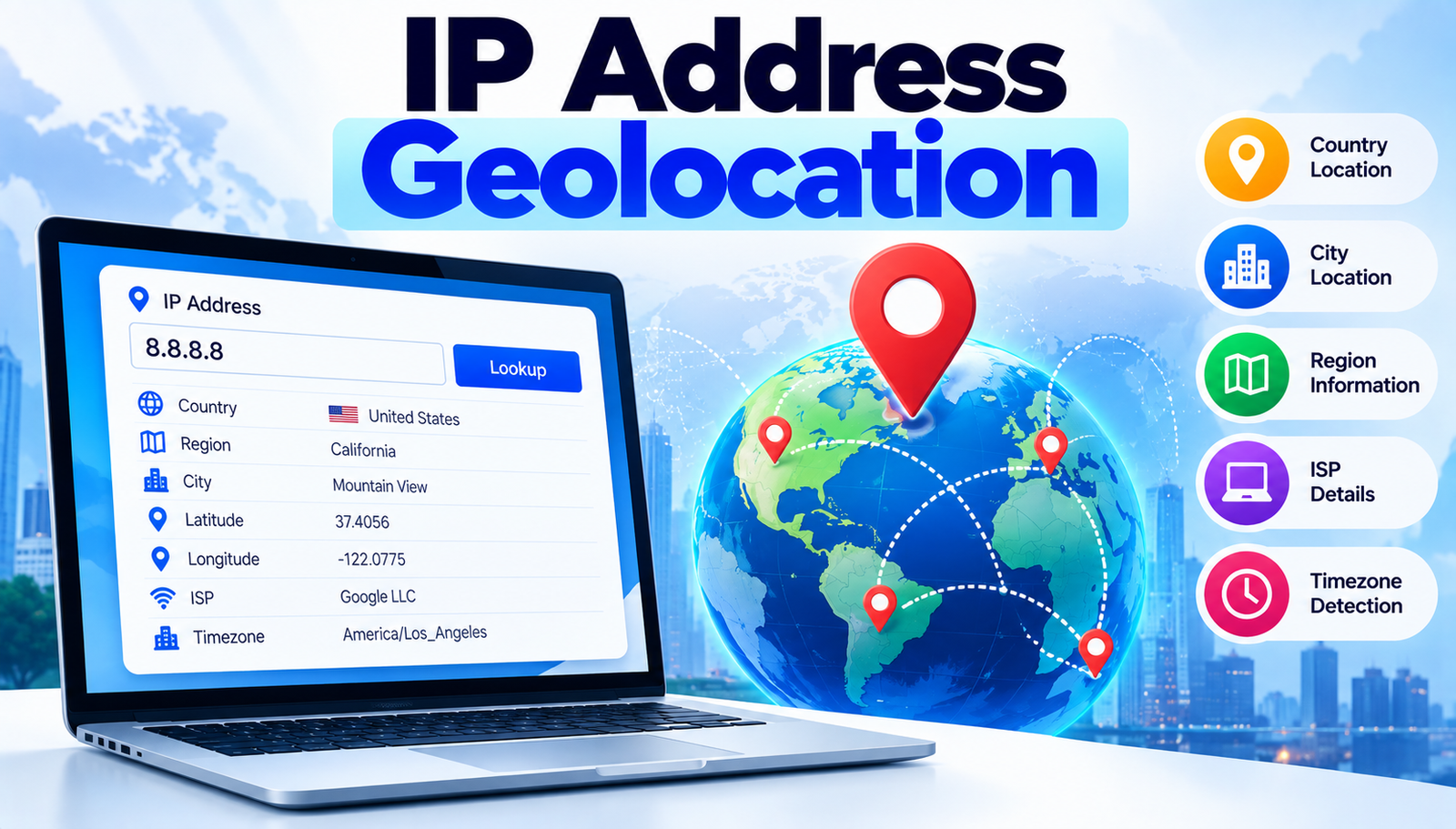
IP address geolocation is the process of mapping an internet protocol address to a physical location typically a country, region, city, or even a specific latitude and longitude. While the concept sounds straightforward, the reality is a tangled web of routing tables, registry allocations, and constantly shifting network topologies. Mainstream guides often claim that an IP address reliably reveals a user’s exact city, but that narrative collapses under scrutiny. The accuracy varies dramatically based on the data source, the type of IP (static, dynamic, mobile), and the underlying methodology.
Beyond the technical definition lies a broader context: geolocation fuels advertising, fraud detection, content licensing, and legal compliance. Each use case demands a different precision level, yet most providers market a one‑size‑fits‑all solution. This conflation creates a false sense of security, leading businesses to ignore the nuanced trade‑offs between cost, accuracy, and latency.
- Country-Level
- Typical Accuracy: >99%
- Best Use Case: Regulatory compliance and licensing
- Common Pitfall: Assuming city-level precision
- Region-Level
- Typical Accuracy: 85–95%
- Best Use Case: Targeted advertising and load balancing
- Common Pitfall: Ignoring VPN and proxy distortions
- City-Level
- Typical Accuracy: 70–85%
- Best Use Case: Local news feeds and weather services
- Common Pitfall: Over-reliance for fraud scoring
- Latitude/Longitude
- Typical Accuracy: 40–60%
- Best Use Case: Mapping services and IoT device placement
- Common Pitfall: Treating it as precise GPS data
Leading IP Address Geolocation Solutions
1. MaxMind GeoIP2 Precision
MaxMind dominates the market with a blend of database licensing and API services. Its GeoIP2 Precision model claims sub‑city accuracy by combining ISP data, routing information, and anonymized user reports.
The platform updates weekly, ensuring that newly allocated IP blocks are reflected promptly. However, its premium tier still suffers from the same fundamental limitation: mobile carriers aggregate large address pools, diluting city‑level fidelity.
Key Benefits:
- Rapid weekly updates keep data fresh.
- Extensive coverage of over 99% of global IP space.
- Rich ancillary data such as ISP, domain, and connection type.
2. IP2Location Cloud
IP2Location offers a cloud‑based API that emphasizes real‑time lookup speed. The service touts a 30‑millisecond average response time, making it attractive for high‑traffic e‑commerce sites.
Its strength lies in the granular city‑level tables, but the accuracy drops sharply for VPN traffic, a growing concern for fraud detection. The provider mitigates this by integrating a separate VPN/Proxy detection module.
Key Benefits:
- Lightning‑fast API response suitable for latency‑sensitive applications.
- Comprehensive dataset covering over 2.5 million cities.
- Built‑in VPN and proxy flagging to improve fraud safeguards.
3. DB-IP Enterprise
DB‑IP positions itself as a cost‑effective alternative for enterprises that need bulk lookups. Its downloadable CSV files are optimized for on‑premise deployment, reducing third‑party dependency.</n
The trade‑off is a longer update cycle typically monthly meaning that fast‑changing ISP re‑assignments lag behind. For static infrastructure monitoring, however, this is a negligible drawback.
Key Benefits:
- Affordable bulk licensing for large‑scale operations.
- On‑premise deployment eliminates external latency.
- Supports custom integration with internal data pipelines.
4. Google Cloud Geolocation API
Google’s API leverages the company’s massive telemetry from Chrome, Android, and Google Maps. This crowdsourced approach yields higher accuracy in densely populated regions, especially for mobile users.
The downside is the opaque pricing model and the fact that Google does not disclose its data collection methodology, raising compliance concerns for GDPR‑sensitive projects.
Key Benefits:
- Superior accuracy in urban environments due to crowd data.
- Seamless integration with other Google Cloud services.
- Scalable pay‑as‑you‑go pricing for variable workloads.
5. Neustar IP Intelligence
Neustar focuses on risk‑based geolocation, combining traditional mapping with behavioural analytics. Its platform excels in fraud prevention, delivering a risk score alongside the location data.
Because it layers multiple data sources, the latency is higher (often >100 ms), making it less suitable for real‑time content personalization but ideal for transaction vetting.
Key Benefits:
- Integrated risk scoring for immediate fraud assessment.
- Deep coverage of enterprise‑grade IP ranges.
- Customizable rule engine to align with specific security policies.
Practical Takeaways
✔ Choose the right granularity
Not every application needs city‑level precision. Align the required accuracy with business impact to avoid unnecessary expense.
✔ Account for mobile carrier aggregation
Mobile IP pools often span entire regions; treat them as a separate class when designing fraud models.
✔ Combine geolocation with device fingerprinting
Layering multiple signals such as browser headers and canvas fingerprints dramatically improves confidence in user location.
✔ Update datasets frequently
IP allocations shift daily. Weekly or daily refreshes are essential for any security‑critical deployment.
✔ Test for VPN and proxy bias
Run regular audits using known VPN exit nodes to measure how much they skew your location metrics.
✔ Deploy on‑premise for latency‑sensitive workloads
When milliseconds matter such as in high‑frequency trading local database lookups beat cloud APIs.
The Next 5 Years
Convergence of 5G and edge computing will push geolocation accuracy to sub‑city levels for mobile users.
Edge nodes will host localized IP databases, reducing lookup latency and enabling real‑time personalization.
1. Privacy regulations will force providers to anonymize datasets, potentially reducing granularity.
Compliance frameworks like GDPR and CCPA will mandate opt‑out mechanisms, limiting data collection from end users.
2. AI‑driven inference will supplement missing geolocation data using traffic patterns and behavioural cues.
Machine learning models will predict probable locations when IP data is ambiguous, improving fraud detection without direct IP mapping.
3. Standardization of ISP‑provided geolocation metadata will emerge, creating a unified global registry.
Regulators will pressure ISPs to publish accurate location tags, reducing reliance on third‑party guesswork.
4. Quantum‑resistant encryption will decouple IP addresses from identity, making geolocation a less reliable proxy for personal data.
As encryption becomes ubiquitous, the correlation between IP and user identity will weaken, reshaping how businesses use location signals.
- MaxMind GeoIP2
- Update Frequency: Weekly
- Average Latency: 15 ms (local)
- Risk Score: No
- IP2Location Cloud
- Update Frequency: Daily
- Average Latency: 30 ms
- Risk Score: Yes (VPN flag)
- DB-IP Enterprise
- Update Frequency: Monthly
- Average Latency: 5 ms (on-prem)
- Risk Score: No
- Google Cloud Geolocation
- Update Frequency: Real-time (crowd-sourced)
- Average Latency: 40 ms
- Risk Score: No
- Neustar IP Intelligence
- Update Frequency: Weekly
- Average Latency: 120 ms
- Risk Score: Yes (risk score)
What It All Means
IP address geolocation is far from the infallible beacon many vendors present; its utility hinges on context, freshness, and complementary signals. By demanding the right granularity, integrating risk layers, and planning for emerging privacy constraints, organizations can turn a noisy data point into a strategic asset.
Adopting a multi‑source, regularly refreshed approach safeguards against the inevitable churn of IP allocations while preserving the agility needed for modern digital experiences.
The future will reward those who blend edge‑deployed databases, AI inference, and rigorous compliance, transforming geolocation from a static lookup into a dynamic intelligence engine.
Contact
Missing something?
Feel free to request missing tools or give some feedback using our contact form.
Contact Us