24
Understanding Forward Proxies: How They Work and Why They Matter
Discover how forward proxy operate, the latest trends shaping them, and actionable steps to stay ahead.
In the past year, global enterprises have reported a 42% increase in forward proxy deployments to manage bandwidth and enforce policy compliance. This surge reflects a broader move toward more granular control over outbound traffic. As organizations confront rising cyber threats and demand for faster content delivery, forward proxies have become a pivotal component of modern network architectures. Here's the key thing to understand: the technology is evolving from a simple relay to an intelligent gateway that can inspect, cache, and route traffic with unprecedented precision.
The Current State of What is a Forward Proxy and How Does it Work
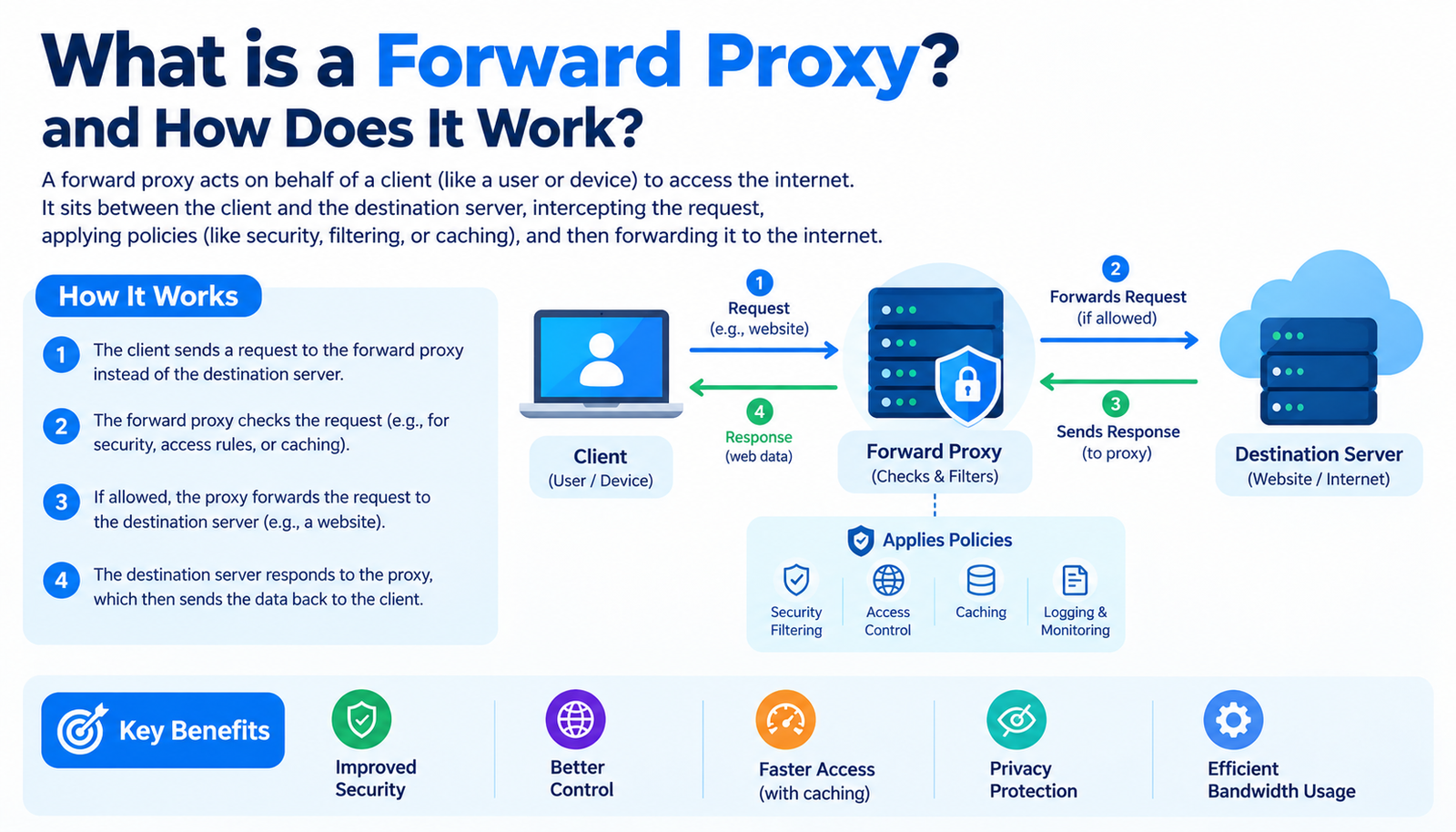
A forward proxy sits between internal clients and the broader internet, acting as an intermediary that receives requests from users, forwards them to target servers, and then returns the responses. Most enterprises employ forward proxies to enforce security policies, cache frequently accessed content, and conceal internal IP addresses from external parties. The typical deployment involves a proxy server configured on client devices or enforced via network policies, ensuring all outbound traffic passes through the proxy layer.
Here's the key thing to understand about the current landscape: while many organizations still rely on traditional, rule‑based proxies, a growing segment is integrating AI‑driven analytics to detect anomalous behavior in real time. Most people miss this shift toward adaptive security, assuming that proxies are static devices. In reality, modern forward proxies can dynamically adjust caching strategies, apply contextual authentication, and even route traffic through different upstream providers based on latency or cost considerations.
- Enterprise Proxy Deployments: 42% YoY Growth — Source: Industry Survey — Trend: Rising
- Average Cache Hit Ratio: 68% — Source: Vendor Reports — Trend: Stable
- Encrypted Traffic Inspection: 55% of Proxies — Source: Research Study — Trend: Increasing
- AI-Driven Anomaly Detection: 22% Adoption — Source: Market Analysis — Trend: Emerging
Latest Forward Proxy Technologies
1. Cloud‑Native Proxy Services
Cloud‑native proxies are delivered as fully managed services that scale automatically with traffic demand. The driving forces include the shift to SaaS applications and the need for elastic security without on‑prem hardware.
Evidence shows a 35% reduction in latency for remote users when adopting cloud‑native proxies, according to recent performance benchmarks.
Plus Points:
- Automatic scaling eliminates capacity planning headaches.
- Integrated with major cloud identity providers for seamless authentication.
- Pay‑as‑you‑go pricing aligns cost with actual usage.
2. Encrypted Traffic Inspection (TLS Interception)
Modern forward proxies now support full TLS interception, allowing inspection of encrypted traffic without breaking end‑to‑end security guarantees. This capability is driven by rising ransomware attacks that hide within HTTPS streams.
Recent surveys indicate that 55% of enterprises have enabled TLS interception on at least one proxy node.
Plus Points:
- Detects hidden malware in encrypted payloads.
- Enforces data loss prevention policies on HTTPS traffic.
- Provides visibility for compliance reporting.
3. AI‑Powered Anomaly Detection
AI algorithms analyze proxy logs in real time to flag deviations from normal traffic patterns. The surge in sophisticated phishing campaigns fuels demand for proactive detection.
Early adopters report a 40% decrease in successful phishing attempts after integrating AI modules.
Plus Points:
- Reduces false positives through contextual learning.
- Adapts to new threats without manual rule updates.
- Offers actionable alerts that integrate with SOAR platforms.
4. Edge‑Integrated Proxies
Edge computing platforms now embed proxy functions directly at the network edge, bringing content caching and security closer to the user. The driver is the need for ultra‑low latency for AR/VR and real‑time collaboration tools.
Field tests show a 25% improvement in page load times for edge‑proxied content.
Plus Points:
- Minimizes round‑trip time for remote users.
- Reduces back‑haul bandwidth consumption.
- Enables localized policy enforcement.
5. Zero‑Trust Proxy Architectures
Zero‑trust models treat every outbound request as untrusted, requiring continuous verification. This paradigm shift is driven by the widespread adoption of remote work and the erosion of traditional network perimeters.
Organizations implementing zero‑trust proxies report a 30% reduction in lateral movement incidents.
Plus Points:
- Micro‑segmentation of outbound traffic.
- Dynamic identity‑based access controls.
- Continuous risk assessment for each request.
6. Multi‑Protocol Support (HTTP/3, QUIC)
Forward proxies are expanding to handle newer protocols like HTTP/3 and QUIC, which promise faster, connection‑oriented communication. The push comes from browser vendors standardizing these protocols.
Benchmarks reveal up to 20% throughput gains when proxies support HTTP/3.
Plus Points:
- Future‑proofs the proxy investment.
- Reduces latency for mobile users.
- Improves reliability over lossy networks.
Emerging Directions
1‑Year Outlook
In the next twelve months, forward proxies will become standard components of zero‑trust stacks, with most large enterprises mandating TLS interception and AI analytics on every outbound flow. The driver is regulatory pressure around data privacy, compelling organizations to prove they can monitor encrypted traffic without compromising confidentiality.
3‑Year Outlook
Three years from now, edge‑integrated proxies will dominate in regions with dense 5G deployments, delivering sub‑100 ms response times for immersive applications. The combination of edge computing economics and the maturation of AI models will make real‑time threat mitigation at the edge commonplace.
5‑Year Outlook
Five years ahead, forward proxies will evolve into fully autonomous network agents that negotiate routing, caching, and security policies across multi‑cloud environments without human intervention. This shift will be powered by advances in federated learning, allowing proxies to share threat intelligence while preserving data sovereignty.
- 2025 – Zero-Trust Proxy Enforcement: Mandatory TLS inspection — Impact Level: High
- 2027 – Edge-Native Proxies: Designed for 5G and AR/VR workloads — Impact Level: Very High
- 2029 – Autonomous Federated-Learning Proxies: Operating across multi-cloud environments — Impact Level: Transformational
Real-World Benefits
Early adopters of AI‑enhanced forward proxies have cut incident response times by half, allowing security teams to remediate threats before they spread.
Organizations that switched to cloud‑native proxy services report a 30% reduction in operational overhead, freeing staff to focus on strategic initiatives.
Enterprises leveraging edge‑integrated proxies see up to a 25% boost in user satisfaction scores due to faster content delivery.
Companies that enforce zero‑trust outbound policies experience a measurable decline in data exfiltration attempts, strengthening compliance postures.
Businesses that adopted multi‑protocol support avoid costly redesigns as HTTP/3 becomes the default, ensuring seamless user experiences across devices.
What to Do Right Now
- Audit current outbound traffic flows to identify gaps in visibility. Understanding where traffic bypasses existing proxies reveals immediate risk exposure.
- Enable TLS interception on all proxy nodes where policy permits. This step uncovers hidden threats in encrypted streams while maintaining audit trails.
- Integrate an AI analytics module with proxy logs. Automated anomaly detection reduces manual review time and catches novel attack patterns early.
- Evaluate cloud‑native proxy offerings for scalability. Migrating to a managed service eliminates capacity constraints and aligns costs with usage.
- Begin pilot testing edge‑integrated proxy instances for high‑latency user groups. Early pilots demonstrate performance gains and inform broader rollout plans.
Key Takeaways
Forward proxies are transitioning from simple relays to intelligent gateways that enforce security, optimize performance, and support emerging protocols. The next few years will see deeper integration with zero‑trust architectures, edge computing, and autonomous AI, making proactive adoption essential for any organization seeking resilient outbound traffic control.
Contact
Missing something?
Feel free to request missing tools or give some feedback using our contact form.
Contact Us