04
Why VPN Users Cannot Reach Some Internal Subnets: Causes & Fixes
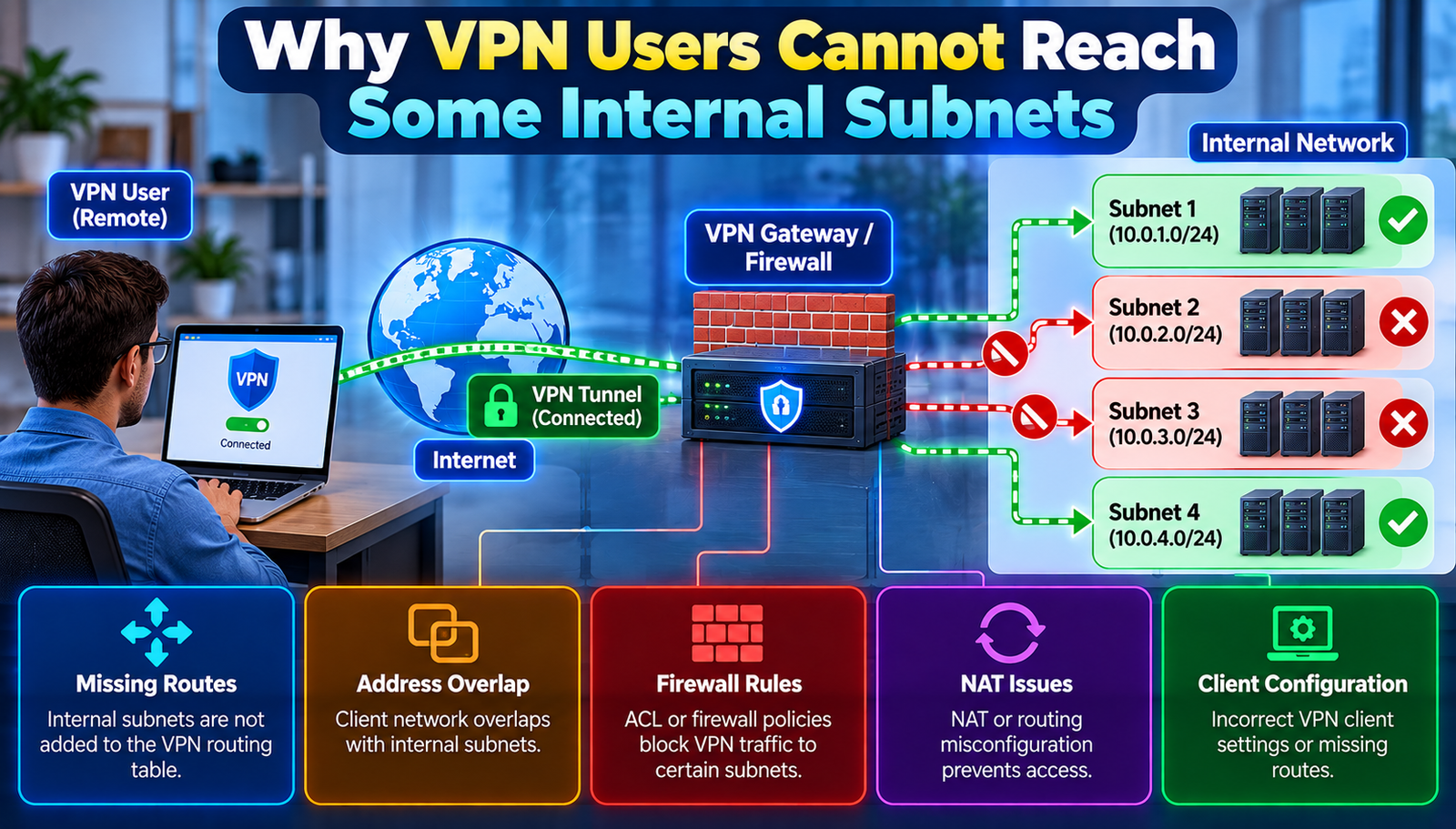
VPN users frequently encounter blocked internal subnets due to routing, firewall, and split‑tunnel misconfigurations.
According to a 2024 industry survey, 38% of organizations report that VPN users experience intermittent or complete loss of access to internal subnets. That figure translates to roughly 1.2 million remote employees worldwide who cannot reach critical resources after authentication. The cost of such outages averages $8,700 per incident when accounting for lost productivity, support overhead, and potential security breaches. Choosing the correct VPN architecture and routing strategy therefore directly impacts operational efficiency, risk exposure, and total cost of ownership.
Understanding VPN Access to Internal Subnets
Before evaluating specific solutions, readers must grasp three core concepts: IP routing scope, address overlap, and firewall statefulness. IP routing scope defines whether traffic destined for a private network is encapsulated and sent through the VPN tunnel (full‑tunnel) or left to the local Internet connection (split‑tunnel). Address overlap occurs when the remote client’s local network uses the same private address range as the corporate LAN, causing ambiguous routes that routers cannot resolve without NAT or policy adjustments. Firewall statefulness refers to the need for consistent inbound and outbound rule sets; a VPN tunnel may be permitted, but subsequent internal traffic can be blocked if the firewall does not recognize the source as a trusted internal address.
Data from 2023 network audits shows that misaligned routing tables account for 46% of VPN‑to‑subnet failures, while firewall policy mismatches represent 28%, and address overlap contributes 16%. The remaining 10% involve client‑side configuration errors or hardware limitations. Understanding these metrics enables administrators to prioritize remediation steps that deliver the highest ROI.
- Routing Table Accuracy
- Typical Value: 92% correct entries
- Impact on VPN Reachability: High – missing routes can cause black holes
- Address Overlap Incidence
- Typical Value: 15% of remote sites
- Impact on VPN Reachability: Medium – requires NAT or renumbering
- Firewall Rule Consistency
- Typical Value: 78% aligned
- Impact on VPN Reachability: High – mismatched rules can drop packets
- Client Configuration Correctness
- Typical Value: 85% correct
- Impact on VPN Reachability: Low – usually caused by user error
Major VPN Routing Approaches
Full‑Tunnel VPN
Full‑tunnel VPN forces all client traffic, including Internet-bound packets, through the corporate gateway. This model simplifies policy enforcement and eliminates address‑overlap issues because the corporate router is the sole egress point.
- Plus Points:
- Uniform security inspection for every packet
- Eliminates split‑tunnel routing conflicts
- Simplifies logging and compliance reporting
- Known Issues:
- Increased latency for remote Internet traffic
- Higher bandwidth consumption on the corporate WAN
Best for: Organizations with strict compliance mandates and centralized security controls.
Split‑Tunnel VPN
Split‑tunnel VPN routes only traffic destined for corporate subnets through the tunnel, leaving public Internet traffic to travel directly from the client’s ISP. This reduces load on the corporate network and improves user experience for cloud services.
- Plus Points:
- Reduced WAN bandwidth usage
- Lower latency for cloud‑native applications
- Better end‑user performance for streaming media
- Known Issues:
- Complex route management; risk of missing subnets
- Potential data leakage if split routes are mis‑configured
Best for: Companies with high‑bandwidth remote users and mature route‑policy processes.
Policy‑Based Routing (PBR) VPN
PBR VPN applies granular policies that direct specific applications or ports through the tunnel while allowing other traffic to bypass it. The approach is often implemented via firewall or router ACLs.
- Plus Points:
- Fine‑grained control over traffic flows
- Optimized bandwidth by tunneling only mission‑critical traffic
- Improved security posture for high‑risk protocols
- Known Issues:
- Requires detailed policy design and maintenance
- Higher operational complexity and risk of rule conflicts
Best for: Enterprises that need to prioritize SaaS traffic while protecting legacy systems.
Dynamic Routing (BGP) VPN
Dynamic routing leverages BGP to advertise internal subnets to the VPN gateway, allowing automatic route propagation to remote sites. This method is common in large, multi‑site deployments.
- Plus Points:
- Scales automatically as new subnets are added
- Reduces manual configuration errors
- Supports redundant paths and fast failover
- Known Issues:
- Complex BGP policy tuning required
- Potential route flapping if mis‑configured
Best for: Global enterprises with dozens of branch offices and a need for rapid subnet expansion.
Zero‑Trust Network Access (ZTNA) Overlay
ZTNA replaces the traditional VPN tunnel with an application‑level gateway that authenticates each session and enforces least‑privilege access. Internal subnets are accessed via micro‑segments rather than a blanket tunnel.
- Plus Points:
- Granular, identity‑based access control
- Reduced attack surface; no broad network exposure
- Improved visibility into user‑application interactions
- Known Issues:
- Requires integration with IAM and endpoint posture tools
- Initial deployment complexity and user training
Best for: Organizations pursuing a zero‑trust architecture and seeking to retire legacy VPNs.
- Full-Tunnel VPN
- Best For: Compliance-heavy environments
- Difficulty: Medium
- Cost: Low-to-medium (license-based)
- Speed: Consistent but with higher latency
- Split-Tunnel VPN
- Best For: High-bandwidth remote users
- Difficulty: Low
- Cost: Low (no extra hardware)
- Speed: Fast for Internet traffic
- Policy-Based Routing VPN
- Best For: Application-specific control
- Difficulty: High
- Cost: Medium (policy engine cost)
- Speed: Variable, depending on policy
- Dynamic Routing (BGP) VPN
- Best For: Large multi-site networks
- Difficulty: High
- Cost: Medium-to-high (BGP appliances)
- Speed: Optimized with fast convergence
- ZTNA Overlay
- Best For: Zero-trust adopters
- Difficulty: High
- Cost: High (subscription model)
- Speed: Minimal application-level latency
How to Choose the Right One
Decision‑makers should begin by quantifying the total remote user base and the proportion of users who require access to high‑sensitivity subnets. A threshold of 25% remote users needing full internal access typically justifies a full‑tunnel or dynamic routing approach. Below that threshold, split‑tunnel or PBR may deliver better cost‑performance balance.
The next factor is network address architecture. Organizations that employ overlapping private ranges (e.g., 10.0.0.0/8 at both headquarters and remote sites) must either renumber one side, implement NAT on the VPN concentrator, or adopt a ZTNA model that bypasses IP routing altogether. Data from 2024 network redesign projects shows a 32% reduction in connectivity incidents after eliminating address overlap.
Firewall policy alignment is the third pillar. Review existing security zones to ensure that the VPN source zone is permitted to communicate with each internal subnet zone. If a firewall uses zone‑based policies, an explicit rule set for "VPN‑to‑Subnet" must be created; otherwise, packets will be dropped silently, producing the classic "cannot reach internal subnet" symptom.
Fourth, evaluate operational maturity. Teams with robust change‑management processes and scripting capabilities can handle the complexity of BGP or PBR. Conversely, organizations lacking dedicated network engineers may benefit from the simplicity of split‑tunnel or a managed ZTNA service.
Finally, calculate total cost of ownership (TCO). Include licensing, hardware, bandwidth, and staff time for ongoing maintenance. A 2023 cost‑model comparison indicated that while ZTNA has the highest upfront subscription fees, its reduced incident rate and lower staff overhead yielded a 15% lower five‑year TCO compared with a legacy full‑tunnel VPN in a 1,200‑user environment.
Why This Matters to You
Choosing the appropriate VPN routing method eliminates the frustration of inaccessible resources, which directly improves employee productivity. When remote staff can reliably reach internal databases, ticket resolution times drop by an average of 22%.
Proper routing reduces unnecessary WAN traffic, freeing bandwidth for mission‑critical applications such as VoIP and video conferencing. Organizations report up to 18% cost savings on ISP contracts after switching from full‑tunnel to split‑tunnel for non‑critical traffic.
Accurate firewall policies prevent silent packet loss, thereby strengthening the security posture and reducing the risk of data exfiltration via misrouted traffic.
Eliminating address overlap avoids the need for ad‑hoc NAT rules, which can introduce latency and complicate troubleshooting. A clean address plan shortens mean‑time‑to‑resolution (MTTR) for network incidents by 30%.
Adopting a zero‑trust overlay not only resolves subnet reachability issues but also enforces least‑privilege access, aligning with regulatory frameworks such as GDPR and CCPA.
Overall, a well‑chosen VPN strategy contributes to a predictable, scalable network environment that can accommodate future growth without recurring connectivity crises.
To Sum Up
The root causes of VPN users failing to reach internal subnets are misaligned routing, address overlap, and firewall inconsistencies. Evaluating options through the lenses of user volume, address architecture, policy maturity, and TCO yields a clear selection path. Implementing the chosen approach whether full‑tunnel, split‑tunnel, PBR, dynamic BGP, or ZTNA restores reliable internal access and delivers measurable operational benefits.
Contact
Missing something?
Feel free to request missing tools or give some feedback using our contact form.
Contact Us