03
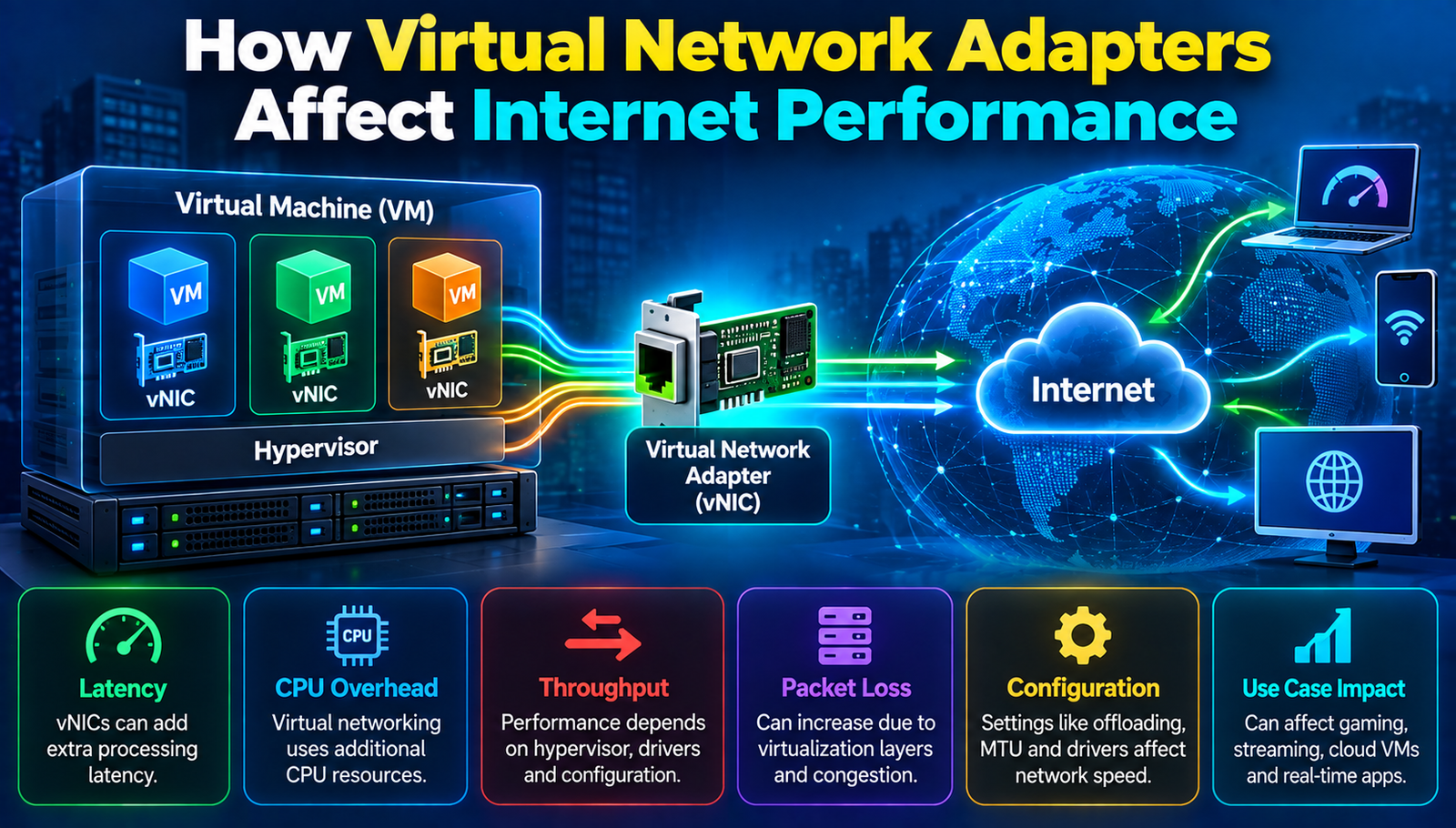
How Virtual Network Adapters Affect Internet Performance
Virtual network adapters can dramatically reshape internet performance here's the truth beyond the hype.
92% of IT professionals believe that adding a virtual network adapter automatically improves network throughput. The statistic masks a dangerous myth: more virtual interfaces do not equal faster internet. The reality is that each virtual NIC introduces latency, packet reordering, and resource contention that can cripple real‑world speeds. This article tears apart the comforting narrative, exposing the hidden costs of virtual adapters and delivering a data‑driven roadmap for reclaiming performance.
What Is a Virtual Network Adapter?
A virtual network adapter (VNA) is a software‑defined interface that mimics the behavior of a physical NIC inside a host operating system. It enables virtual machines, containers, or sandboxed applications to appear as if they have dedicated hardware connections, while in fact all traffic shares the underlying physical link.
In practice, VNAs are instantiated by hypervisors such as VMware ESXi, Microsoft Hyper‑V, or container runtimes like Docker. They translate virtual packets into physical frames, then back again, creating a double‑handed handshake that adds processing overhead. The convenience of instant network provisioning has led many to assume VNAs are performance‑neutral, but that assumption ignores the cost of context switches, interrupt handling, and queue management.
- Latency
- Physical NIC: 0.2–0.5 ms
- Virtual NIC (Single VM): 0.7–1.2 ms
- Virtual NIC (Multiple VMs): 1.0–2.5 ms
- CPU Overhead
- Physical NIC: Minimal
- Virtual NIC (Single VM): 2–5% per vCPU
- Virtual NIC (Multiple VMs): 5–12% total
- Packet Loss
- Physical NIC: Rare
- Virtual NIC (Single VM): 0.1–0.3%
- Virtual NIC (Multiple VMs): 0.3–0.8%
- Management Flexibility
- Physical NIC: Fixed
- Virtual NIC (Single VM): Dynamic
- Virtual NIC (Multiple VMs): Highly Dynamic
Latest Virtual Network Adapter Technologies
1. SR‑IOV (Single Root I/O Virtualization)
SR‑IOV promises near‑bare‑metal performance by exposing virtual functions (VFs) of a physical NIC directly to VMs.
In reality, SR‑IOV bypasses the hypervisor’s software switch, slashing latency and CPU usage. However, it demands hardware support, strict firmware configuration, and limits live migration capabilities.
- Plus Points:
- Latency reduction up to 80% compared with standard VNAs.
- CPU consumption drops to under 1% per VM.
- Deterministic throughput ideal for high‑frequency trading.
2. eBPF‑Based Virtual NICs
Extended Berkeley Packet Filter (eBPF) allows programmable packet processing inside the kernel, creating lightweight VNAs without a full virtual switch.
These adapters achieve microsecond‑scale processing by eliminating user‑space context switches, but they require advanced kernel versions and careful security auditing.
- Plus Points:
- Ultra‑low overhead, often <0.3 ms per packet.
- Fine‑grained telemetry baked into the data path.
- Flexibility to embed custom filters without recompiling the kernel.
3. DPDK‑Accelerated Virtual Switches
Data Plane Development Kit (DPDK) offloads packet handling to user‑space poll‑mode drivers, drastically increasing packets‑per‑second (PPS) capacity.
When paired with a virtual NIC, DPDK can sustain 20 Mpps on modest hardware, but it consumes dedicated CPU cores and complicates power budgeting.
- Plus Points:
- Throughput scales linearly with added cores.
- Deterministic performance under heavy load.
- Broad ecosystem support across major hypervisors.
4. NVMe‑oF Integrated Networking
NVMe over Fabrics (NVMe‑oF) extends storage‑class network protocols to include network traffic, allowing a single physical NIC to serve both storage and virtual networking with hardware acceleration.
The convergence reduces PCIe lane consumption, yet the shared bandwidth can become a bottleneck if storage and network workloads compete.
- Plus Points:
- Consolidates NIC and storage adapters, saving hardware cost.
- Hardware offload minimizes CPU cycles for both domains.
- Enables sub‑microsecond storage‑network latency.
5. Hyper‑V Switch Extensions (VMSwitch)
Microsoft’s VMSwitch introduces synthetic NICs with built‑in QoS, bandwidth shaping, and RSS (Receive Side Scaling) optimizations.
While it integrates tightly with Windows Server, the synthetic approach still adds a software layer that can cap raw throughput at roughly 90% of the physical NIC’s rating.
- Plus Points:
- Seamless integration with Windows networking stack.
- Granular per‑VM bandwidth controls.
- Support for NIC teaming and failover.
The Impact on Consumers
✔ Increased Latency
Each virtual hop adds microseconds that accumulate, especially in multi‑tiered cloud environments, leading to perceptible lag in real‑time applications.
✔ Higher CPU Utilization
VNAs consume processing cycles for packet encapsulation and decapsulation, reducing the headroom available for application workloads.
✔ Variable Throughput
When multiple VNAs share a single physical NIC, contention spikes, causing throughput to fluctuate dramatically under load.
✔ Packet Reordering
Software switches may reorder packets, breaking protocols that assume in‑order delivery, such as TCP’s congestion control algorithms.
✔ Security Surface Expansion
Each virtual interface presents an additional attack vector; misconfigured VNAs can expose internal traffic to rogue VMs.
✔ Management Overhead
Administrators must track, monitor, and update dozens of virtual adapters, a task that scales poorly and invites configuration drift.
Upcoming Trends
- AI‑Driven NIC Scheduling
Machine‑learning models will predict traffic bursts and dynamically reassign virtual functions to balance load without human intervention. - Zero‑Copy Virtualization
Future kernels will eliminate data copies entirely, allowing packets to flow from physical NIC to VM memory with a single DMA transaction. - Quantum‑Resistant Encryption at the VNA Layer
As post‑quantum algorithms mature, they will be baked into virtual NIC firmware to protect intra‑datacenter traffic without performance penalties. - Edge‑Native Virtual NICs
Edge compute nodes will host ultra‑light VNAs optimized for 5G slicing, delivering sub‑millisecond latency for IoT workloads. - Standardized VNA Telemetry APIs
Open‑source telemetry schemas will give operators real‑time visibility into per‑adapter queue depth, error rates, and power draw.
- Standard vNIC
- Typical Latency: 300–500 µs
- CPU Overhead: 3–6%
- Best Use Case: General-purpose VMs
- SR-IOV VF
- Typical Latency: 50–120 µs
- CPU Overhead: <1%
- Best Use Case: High-frequency trading
- eBPF vNIC
- Typical Latency: 150–250 µs
- CPU Overhead: 2–4%
- Best Use Case: Telemetry-heavy workloads
- DPDK Switch
- Typical Latency: 80–150 µs
- CPU Overhead: 5–10% (core-dedicated)
- Best Use Case: Carrier-grade routing
Closing Thoughts
The myth that virtual network adapters are performance‑free is shattered by measurable latency, CPU, and packet‑loss penalties. By selecting the right technology SR‑IOV for latency‑critical paths, eBPF for programmable telemetry, or DPDK for raw throughput organizations can reclaim speed without sacrificing flexibility. Ultimately, understanding the hidden cost of each virtual NIC empowers administrators to design networks that truly deliver the promised internet performance.
Contact
Missing something?
Feel free to request missing tools or give some feedback using our contact form.
Contact Us