03
Domain Typo Density: Meaning, Calculation & Why It Matters
Typo density of domains reveals hidden SEO opportunities and risks, guiding smarter domain strategy decisions.
Bold statement: Typo density of domains is reshaping how marketers assess brand safety and SEO potential. Choosing the right approach to measuring and acting on typo domains matters because it directly influences traffic capture, brand protection, and competitive advantage. Most people miss this subtle metric, assuming that only exact‑match domains matter. In reality, a high typo density can signal both hidden opportunities and serious risks. This guide explains why understanding typo density is essential before any domain‑related decision is made.
Defining Typo Density of Domains
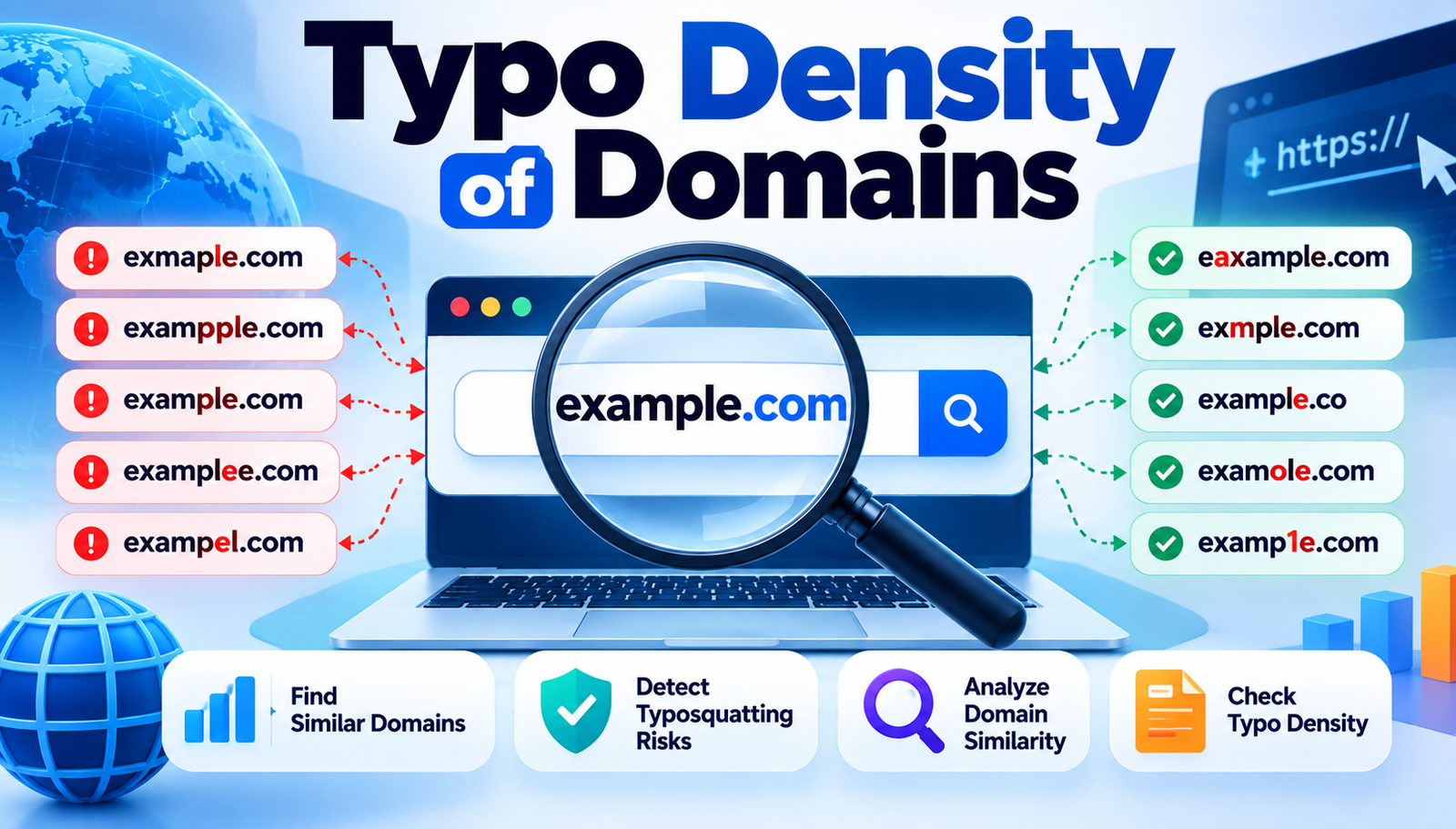
Before diving into tools and techniques, it is crucial to define what typo density actually measures. In simple terms, typo density is the proportion of misspelled variations of a primary domain that exist across the internet. These variations can be created intentionally (by competitors or cybersquatters) or unintentionally (by users typing the wrong characters). The metric is usually expressed as a percentage of the total possible typo permutations that are registered or actively used.
Here's the key thing to understand: typo density is not just a raw count of typo domains; it is a normalized figure that accounts for the length of the original domain and the size of the typo space. A short domain (e.g., "cat.com") has fewer possible typos than a longer one (e.g., "internationaltravel.com"), so the same number of typo domains represents a higher density for the short name. Recognizing this nuance helps marketers compare brands of different lengths on an equal footing.
- Total Possible Typos
- What It Indicates: All permutations generated by common typo models, such as swaps, omissions, and substitutions.
- Why It Matters: Sets the denominator for density calculation.
- Registered Typos
- What It Indicates: Number of typo permutations that are actually registered as domains.
- Why It Matters: Shows how many typo domains are potentially in use.
- Active Typos
- What It Indicates: Registered typo domains that resolve to live websites or redirects.
- Why It Matters: Distinguishes parked or inactive domains from those that can affect traffic.
- Typo Density (%)
- What It Indicates: (Active Typos / Total Possible Typos) × 100
- Why It Matters: Provides a normalized measure for comparison across brands.
Latest Typo Density Technologies
1. Typosquat Scanner Pro
Typosquat Scanner Pro is a cloud‑based platform that generates the full set of possible typos for any given domain and checks their registration status in real time.
Plus Points:
- Fast API response time, suitable for large‑scale audits
- Built‑in classification of active vs. parked domains
- Customizable typo models (keyboard adjacency, phonetic similarity)
Hurdles to Overcome:
- Higher cost for enterprise tier
- Requires API integration knowledge for full automation
Best for: Organizations that need continuous monitoring and integration with security workflows.
2. Domain Typos Analyzer (Open Source)
This open‑source Python library lets users generate typo permutations locally and query WHOIS databases to assess registration.
Plus Points:
- No licensing fees, fully customizable
- Runs offline, preserving privacy
- Extensive community documentation and plugins
Hurdles to Overcome:
- Steeper learning curve for non‑technical users
- Manual WHOIS rate limits can slow large batches
Best for: Technical teams that prefer full control and zero recurring costs.
3. BrandGuard Typo Watch
BrandGuard offers a SaaS dashboard focused on brand protection, automatically alerting users when new typo domains appear.
Plus Points:
- Real‑time alerts via email and webhook
- Integrated threat intelligence for malicious typo domains
- User‑friendly UI suitable for marketers
Hurdles to Overcome:
- Limited export capabilities for bulk analysis
- Pricing tiers based on number of monitored domains
Best for: Brands that prioritize security and need a hands‑off monitoring solution.
4. SEO Typosuite
SEO‑focused platform that combines typo density analysis with keyword traffic estimation, helping SEOs quantify potential lost clicks.
Plus Points:
- Shows estimated traffic loss per typo domain
- Integrates with popular SEO tools (Google Search Console, Ahrefs)
- Provides recommendations for redirects or acquisitions
Hurdles to Overcome:
- Traffic models are based on assumptions, not real data for every typo
- Monthly subscription can add up for agencies managing many clients
Best for: SEO professionals who need a direct link between typo density and traffic impact.
5. DomainMetrics AI
AI‑driven service that predicts the future value of typo domains based on historical auction data and search trends.
Plus Points:
- Predictive scoring helps prioritize acquisition efforts
- Machine‑learning models adapt to emerging typo patterns
- Provides cost‑benefit analysis for each typo domain
Hurdles to Overcome:
- Model transparency is limited; users must trust black‑box predictions
- Requires a minimum data subscription to access AI features
Best for: Companies looking to invest in high‑value typo domains rather than merely monitor them.
- Typosquat Scanner Pro
- Best For: Continuous monitoring & security workflows
- Difficulty: Medium (API integration)
- Cost: High (enterprise pricing)
- Speed: Very Fast (cloud API)
- Domain Typos Analyzer
- Best For: Full control with zero recurring fees
- Difficulty: High (coding required)
- Cost: None (open source)
- Speed: Variable (depends on local resources)
- BrandGuard Typo Watch
- Best For: Brand protection with minimal setup
- Difficulty: Low (UI-driven)
- Cost: Medium (tiered subscription)
- Speed: Fast (real-time alerts)
- SEO Typosuite
- Best For: Linking typo density to traffic loss
- Difficulty: Medium (SEO tool integration)
- Cost: Medium (monthly plan)
- Speed: Fast (dashboard queries)
- DomainMetrics AI
- Best For: Predictive acquisition strategy
- Difficulty: Medium (learning AI output)
- Cost: High (data subscription)
- Speed: Moderate (model processing)
How to Choose the Right One
Choosing the optimal typo‑density solution begins with a clear understanding of organizational goals. Goal alignment is the first decision factor: if the primary aim is brand protection, a tool with real‑time alerts and threat intelligence (like Brand Guard Typo Watch) will outweigh raw speed. Conversely, if the objective is to capture lost traffic, a platform that quantifies estimated clicks (such as SEO Typo suite) becomes more valuable.
Second, assess internal expertise. Technical capacity determines whether an open‑source library like Domain Typos Analyzer is feasible. Teams without a dedicated developer may find the learning curve prohibitive, leading to wasted time and potential errors. In those cases, a managed SaaS with a friendly UI saves resources.
Third, consider budget constraints. While enterprise‑grade services deliver high speed and extensive data, they come with premium price tags. Cost‑benefit analysis should weigh the monetary value of recovered traffic or avoided brand abuse against the recurring subscription fees. For startups, starting with a free or low‑cost option and scaling later often makes sense.
Fourth, evaluate data freshness and coverage. Update frequency matters because new typo domains appear daily. Tools that scrape registrar data hourly will provide a more accurate density picture than those that update weekly. Also, verify whether the service includes internationalized domain names (IDNs) if the brand operates globally.
Finally, think about integration needs. If the organization already uses a SEO stack or a security information and event management (SIEM) system, selecting a solution with native connectors simplifies workflow automation. Integration compatibility reduces manual effort and ensures typo‑density insights feed directly into decision‑making pipelines.
What This Means in Practice
Understanding typo density empowers marketers to reclaim traffic that would otherwise be lost to misspelled searches. By identifying active typo domains, a brand can implement 301 redirects, capturing both users and link equity. This practice directly improves organic rankings for the primary domain.
From a security perspective, monitoring typo density helps detect malicious actors who register typo variants for phishing or malware distribution. Early detection enables rapid takedown requests, protecting both brand reputation and user safety.
For product teams, a low typo density can indicate strong brand awareness, while a high density may signal confusion in the market. This insight can guide naming conventions for future products or sub‑brands, reducing future typo‑related friction.
Acquisition strategies benefit as well. High‑value typo domains identified through predictive tools like DomainMetrics AI can be purchased at a fraction of their market price, providing an inexpensive shortcut to additional keyword rankings.
Customer support teams also gain from typo‑density awareness. When users report difficulty finding a website, support can quickly check whether a typo variant is causing the issue and advise the appropriate redirect.
Finally, advertisers can refine paid‑search campaigns by excluding traffic that lands on typo domains, improving budget efficiency and ensuring ad spend drives actual conversions.
One Last Thing
Typo density is a measurable, actionable metric that bridges SEO, brand protection, and strategic growth. By evaluating goals, expertise, budget, data freshness, and integration needs, organizations can select the solution that delivers the greatest return. The right choice turns a hidden risk into a competitive advantage.
Contact
Missing something?
Feel free to request missing tools or give some feedback using our contact form.
Contact Us