03
TCP Segmentation Offload (TSO) Explained: How It Changes Packet Captures
TCP Segmentation Offload reshapes packet captures, requiring new strategies for reliable network analysis.
Network engineers often spend countless hours sifting through packet captures to pinpoint why a web page loads slowly, a video stream buffers, or a database query stalls. In many cases, the root cause lies not in the application code but in the way the operating system handles large data transfers over TCP (Transmission Control Protocol) the fundamental protocol that ensures reliable delivery of data across the internet. When a server or a client enables TCP Segmentation Offload (TSO), the network stack hands off the job of breaking a large data block into smaller Ethernet frames to the network interface card (NIC). This offload dramatically improves throughput and reduces CPU usage, but it also rewrites the packet stream that a capture tool sees. The result is a capture that looks perfectly normal while actually hiding the segmentation that occurred, making troubleshooting more challenging.
Imagine trying to understand a story when the pages have been shuffled and some chapters are missing. That is similar to analyzing a capture taken on a system with TSO enabled: the story of the data flow is still there, but the details of how the large blocks were split into wire‑level packets are invisible. This article explains what TSO is, how it changes what a packet capture contains, why those changes matter, and what engineers can do to get accurate visibility into network traffic.
A Closer Look at TCP Segmentation Offload
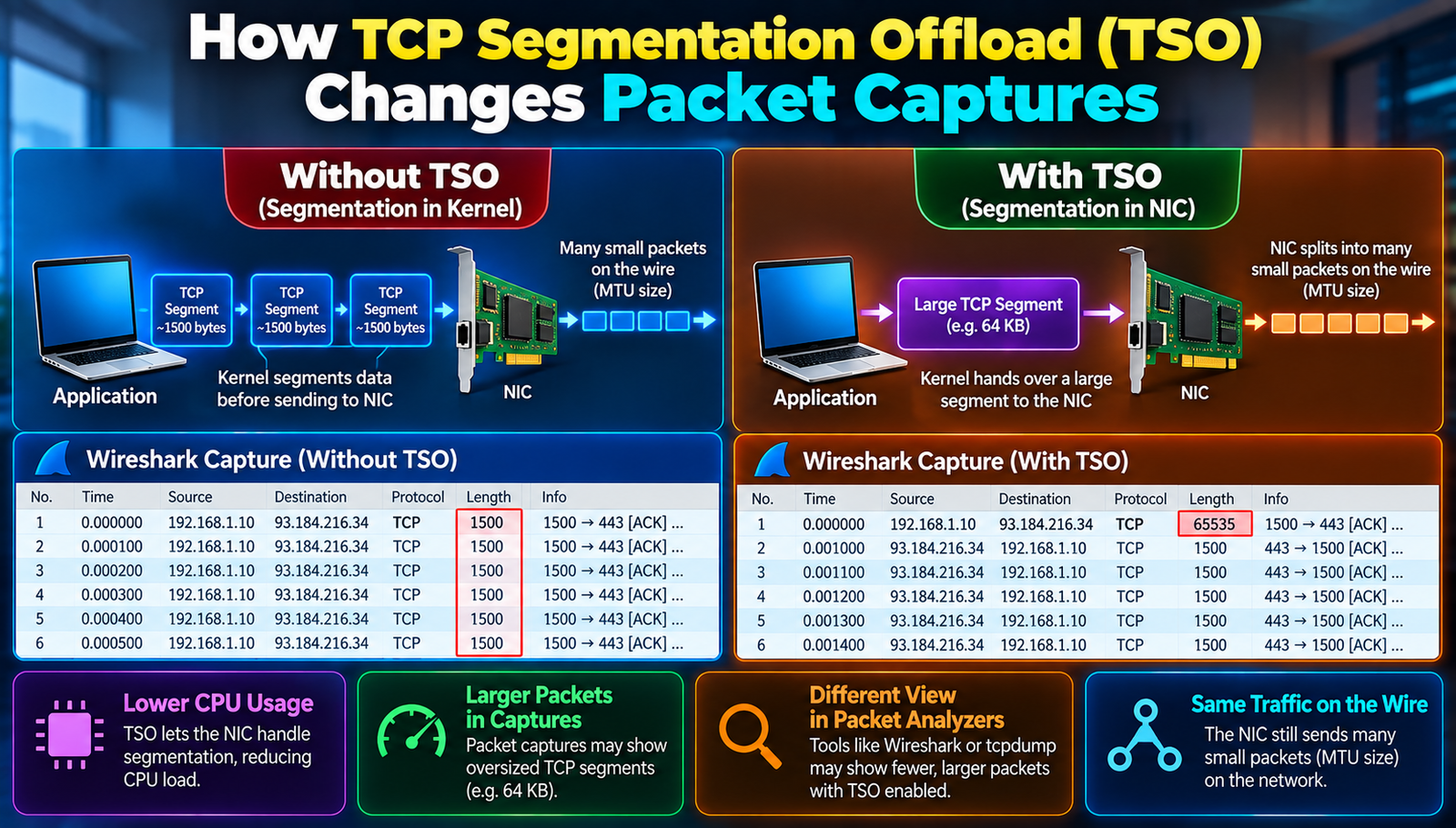
TCP Segmentation Offload (TSO) sometimes called Large Segment Offload (LSO) is a feature of modern network interface cards (NICs) that moves the task of breaking a large TCP segment into multiple Ethernet frames from the operating system's kernel to the NIC hardware. In plain terms, instead of the CPU chopping a 64 KB block of data into 1,500‑byte packets (the typical maximum Ethernet payload), the CPU hands the whole block to the NIC, and the NIC creates the individual frames on the fly. This reduces CPU cycles spent on packetization and can increase overall throughput, especially on high‑speed links such as 10 GbE or 40 GbE.
When TSO is active, the packet capture taken on the host (using tools like Wireshark or tcpdump) sees the large, pre‑segmented TCP segment as a single packet. The NIC later splits it into multiple frames that travel on the wire, but those additional frames never appear in the capture because they are generated after the capture point. Consequently, the captured packet appears larger than the maximum Ethernet payload and may have a TCP payload size that exceeds the wire's MTU (Maximum Transmission Unit). This discrepancy can confuse analysts who expect to see standard‑sized Ethernet frames.
- Where Segmentation Occurs
- Without TSO: Segmentation happens in the kernel before data is sent to the NIC.
- With TSO: The NIC hardware performs segmentation after receiving a large segment from the kernel.
- CPU Usage
- Without TSO: Higher CPU usage because the kernel handles packetization.
- With TSO: Lower CPU usage because the NIC handles segmentation.
- Captured Packet Size
- Without TSO: Standard Ethernet MTU, typically around 1500 bytes.
- With TSO: Captures may show oversized TCP segments, sometimes reaching tens of kilobytes.
- Number of Packets on the Wire
- Without TSO: One packet is sent for each captured packet.
- With TSO: The large segment is split into many packets, each typically sized to the MTU.
The table above highlights the core differences that matter to anyone reviewing captures. The most striking effect is the mismatch between what the capture shows and what actually traverses the network. This mismatch can lead to false conclusions about latency, retransmissions, or even security anomalies.
Key TCP Segmentation Offload Advancements
1. Adaptive Segmentation Size
Modern NICs can dynamically adjust the size of the segment they offload based on the current link speed and congestion state. This adaptability means the offloaded segment can be larger on a 40 GbE link and smaller on a 1 GbE link, optimizing performance.
The NIC monitors the path MTU and the flow control signals, then decides the optimal segment size that balances throughput and latency. By avoiding a one‑size‑fits‑all approach, the system reduces the chance of fragmentation downstream.
- Key Benefits:
- Higher throughput on fast links because larger segments reduce per‑packet overhead.
- Reduced latency for latency‑sensitive applications, as fewer packets need to be processed.
- Better compatibility with variable‑MTU networks, lowering the risk of dropped packets.
2. Hardware‑Accelerated Checksum Calculation
In addition to segmentation, many NICs also compute the TCP checksum a value used to verify data integrity directly in hardware. This eliminates the need for the kernel to calculate the checksum for each segment.
The hardware checksum engine works in parallel with the segmentation engine, ensuring that each generated Ethernet frame carries a correct checksum without CPU involvement.
- Key Benefits:
- Further CPU cycle savings, freeing resources for application processing.
- Reduced chance of checksum errors caused by software bugs.
- Consistent checksum correctness across all offloaded packets.
3. Integrated Large Receive Offload (LRO)
Large Receive Offload (LRO) is the counterpart of TSO for inbound traffic. The NIC coalesces multiple incoming Ethernet frames into a single large TCP segment before delivering it to the kernel.
This coalescing reduces the number of interrupts the CPU must handle, improving inbound processing efficiency. When both TSO and LRO are enabled, the system can achieve symmetrical performance gains for both sending and receiving data.
- Key Benefits:
- Lower interrupt rate improves CPU cache utilization.
- Higher effective inbound bandwidth, especially for bulk data transfers.
- Simplifies application‑level processing by presenting larger, contiguous data buffers.
4. Zero‑Copy Buffer Management
Zero‑copy refers to a technique where data is transferred directly between application memory and the NIC without intermediate copying. When TSO is combined with zero‑copy, the application writes data into a buffer that the NIC can directly access.
This eliminates the traditional copy‑from‑user‑space‑to‑kernel‑space step, dramatically reducing memory bandwidth consumption and latency.
- Key Benefits:
- Reduced memory bandwidth usage, freeing capacity for other workloads.
- Lower end‑to‑end latency for large data transfers.
- Decreased CPU overhead, leading to better overall system scalability.
5. Enhanced Multi‑Queue Support
Modern NICs support multiple transmit and receive queues, allowing parallel processing of different traffic flows. TSO can be applied per‑queue, enabling fine‑grained control over which flows receive offload benefits.
This queue‑aware offload helps maintain quality of service (QoS) guarantees, as high‑priority traffic can be kept on a dedicated queue with its own offload settings.
- Key Benefits:
- Improved traffic isolation, preventing noisy flows from impacting latency‑critical streams.
- Better utilization of multi‑core CPUs by spreading work across cores.
- Fine‑tuned performance tuning per application or service class.
What This Means in Practice
✔ Capture Size Mismatch
Analysts will see TCP payloads larger than the Ethernet MTU, which can be mistaken for protocol errors. Understanding that TSO creates these oversized packets in the capture prevents false alarms.
✔ Hidden Retransmissions
If a packet is lost on the wire, the NIC will retransmit the missing Ethernet frames, but the capture may still show a single large segment, obscuring the retransmission event.
✔ Timing Distortions
Because the segmentation occurs after the capture point, timestamps in the capture reflect when the large segment entered the NIC, not when each individual Ethernet frame left it. This can make latency measurements appear shorter than they truly are.
✔ Difficulty in Calculating Throughput
Throughput calculations based on captured byte counts will overestimate the actual wire‑level data rate, as the capture aggregates multiple frames into one.
✔ Security Analysis Challenges
Intrusion detection systems (IDS) that rely on packet‑level signatures may miss malicious payloads split across multiple frames, because the capture presents a single unsplit segment.
✔ Troubleshooting Missteps
Engineers may spend time chasing non-existent TCP window‑size problems, when the real issue is that TSO hid the true segment boundaries that affect flow control.
Upcoming Trends
1. Integration of TSO with programmable data‑plane languages (e.g., P4) will allow dynamic offload policies based on application intent.
This will let administrators enable or disable offload on a per‑flow basis without restarting services, improving flexibility.
2. AI‑driven capture tools will automatically detect TSO‑induced anomalies and annotate captures with the likely on‑wire packet layout.
Machine learning models trained on both offloaded and non‑offloaded traffic will suggest corrective actions.
3. Standardization of a new capture format (e.g., pcapng extensions) that records NIC offload metadata alongside packet data.
This metadata will include the original segment size, offload flags, and timestamps for each generated frame.
4. Wider adoption of TCP‑based transport protocols like QUIC will prompt NIC vendors to implement offload equivalents for UDP‑based streams.
Such offloads will need to preserve the encrypted payload boundaries while still providing performance gains.
5. Edge computing devices will expose fine‑grained TSO controls through container orchestration platforms.
Developers will be able to toggle offload settings per container, ensuring that micro‑services have the appropriate balance of latency and throughput.
- tcpdump
- TSO Awareness: Limited; requires -s to capture the full segment
- Mitigation Feature: Use -w with raw mode or capture traffic on a network tap
- Wireshark
- TSO Awareness: Shows the TSO flag when reported by the NIC
- Mitigation Feature: Enable Decode As for a TSO-reassembled view
- tshark
- TSO Awareness: Command-line equivalent of Wireshark
- Mitigation Feature: Apply the -R "tcp.segment" filter
- Microsoft Message Analyzer
- TSO Awareness: Limited Windows support
- Mitigation Feature: Capture traffic on the physical NIC instead of a virtual adapter
Wrapping Up
TCP Segmentation Offload offers clear performance benefits but reshapes the packet stream that capture tools observe, introducing size mismatches, hidden retransmissions, and timing distortions. Recognizing these effects allows analysts to adjust their methodology, use appropriate capture points, and apply mitigation techniques to obtain an accurate view of on‑wire traffic. By staying aware of current advancements and upcoming trends, network professionals can harness TSO's efficiency while maintaining reliable visibility into their networks.
Contact
Missing something?
Feel free to request missing tools or give some feedback using our contact form.
Contact Us