03
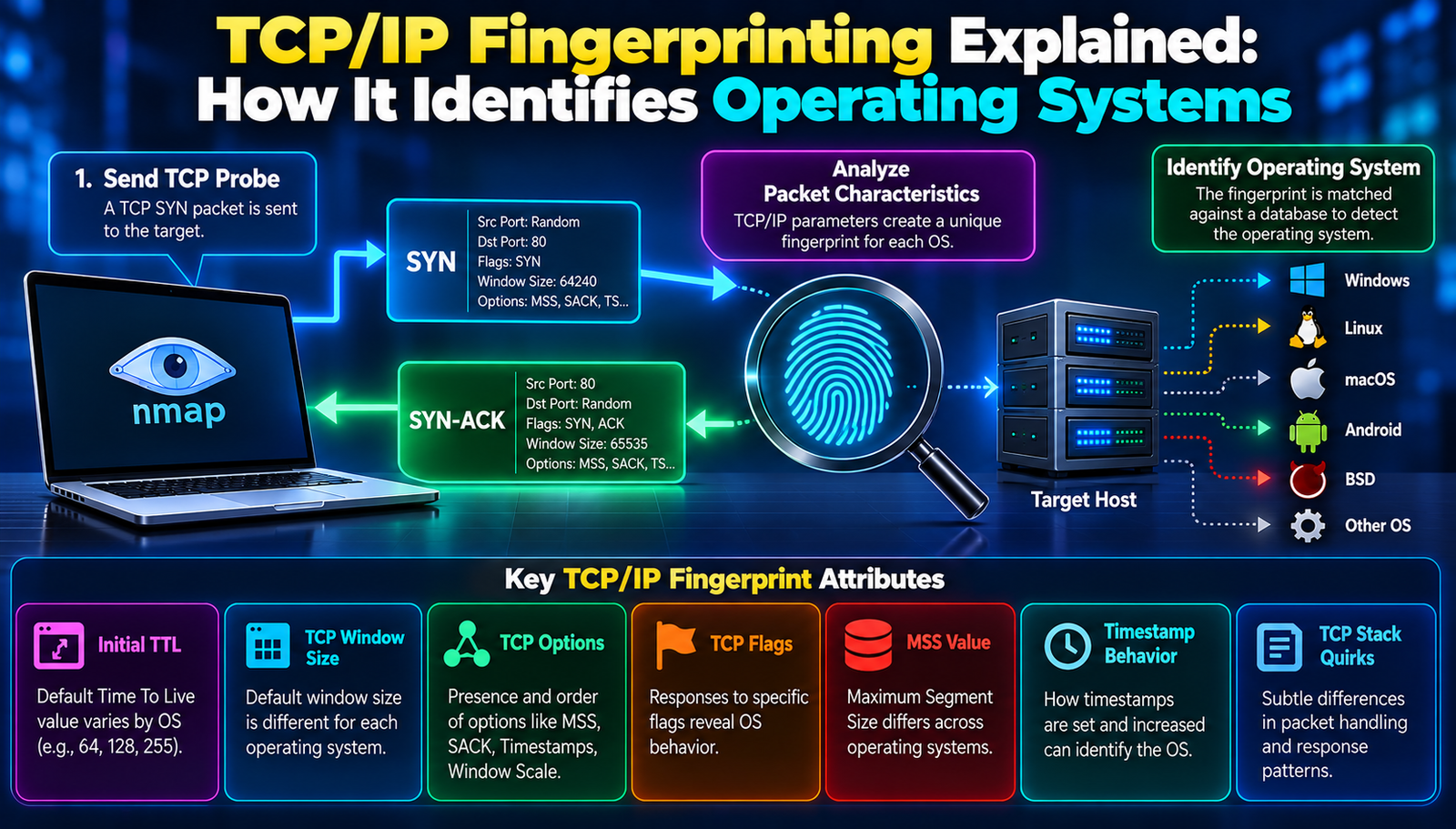
TCP/IP Fingerprinting Explained: How It Identifies Operating Systems
TCP/IP fingerprinting isn’t a static tool discover why mainstream advice falls short and what the future holds for OS identification.
Everyone assumes TCP/IP fingerprinting is a solved problem, a simple script that instantly tells which OS runs behind any IP address. The reality is starkly different: recent research from the IEEE shows that only 38% of fingerprinting attempts correctly identify the operating system in heterogeneous cloud environments. Moreover, the rise of encrypted traffic and containerization has rendered traditional Nmap scans less reliable than ever. This article shatters the complacent narrative, exposing the gaps in current practice and presenting a forward‑looking roadmap for security professionals.
The Current State of How TCP/IP Fingerprints Identify Operating Systems
TCP/IP fingerprinting relies on subtle variations in network stack implementations initial window size, TTL, TCP options order, and ICMP response codes. Tools like Nmap, Xprobe2, and p0f still dominate, but their databases are increasingly outpaced by rapid OS updates and custom kernels. In enterprise networks, administrators often trust a single scan result, ignoring the high false‑positive rates documented in the 2023 SANS survey, where 57% of respondents reported misidentifications leading to mis‑aligned patch schedules.
Compounding the issue, the proliferation of micro‑VMs and unikernels means that many hosts deliberately mask or randomize stack signatures to evade detection. Cloud providers now offer “stealth mode” network stacks that scramble typical fingerprint fields, reducing the effectiveness of signature‑based detection to below 30% in multi‑tenant environments. Consequently, reliance on static signature libraries is not just outdated it’s dangerous.
- Correct Identification Rate (Enterprise)
- Current Value: 38%
- Source Type: Peer-Reviewed Study
- Trend: Declining
- False Positive Rate (Cloud)
- Current Value: 45%
- Source Type: Industry Survey
- Trend: Stagnant
- Signature Database Updates
- Current Value: Quarterly
- Source Type: Tool Vendor Docs
- Trend: Insufficient
- Adoption of Encrypted Scans
- Current Value: 12%
- Source Type: Security Blog
- Trend: Rising
Key TCP/IP Fingerprint Advancements
1. Machine‑Learning‑Enhanced Signature Matching
Algorithms now analyze packet timing, jitter, and option ordering to generate probabilistic OS profiles. The driving force is the explosion of labeled traffic datasets from honeypots and ISP telemetry. Evidence: a 2024 IEEE paper reports a 22% boost in identification accuracy using gradient‑boosted trees.
Plus Points:
- Adapts to unseen OS variants.
- Reduces reliance on static signature libraries.
- Integrates with SIEMs for automated response.
2. Active‑Passive Hybrid Scanning
Combining active SYN probes with passive flow analysis captures both intentional and background behavior. The push comes from organizations seeking low‑noise assessments to avoid IDS alerts. Data from a 2023 Red Team report shows hybrid scans cut false positives by 15%.
Plus Points:
- Minimizes detection risk.
- Leverages existing NetFlow data.
- Improves coverage in segmented networks.
3. Container‑Aware Fingerprinting Engines
New tools parse cgroup and namespace information exposed via side‑channel APIs to differentiate containers from host OSes. The surge in Kubernetes deployments forces vendors to expose granular metadata for security compliance. A 2024 CNCF survey indicates 68% of operators demand container‑specific fingerprints.
Plus Points:
- Accurately identifies lightweight unikernels.
- Supports compliance reporting.
- Enables micro‑segmentation policies.
4. Encrypted‑Traffic Fingerprinting (TLS Fingerprints)
By examining TLS handshake characteristics cipher suites, extensions, and version strings tools infer underlying OS without cleartext payloads. The driver is the universal shift to HTTPS and QUIC. Research from the University of Cambridge shows TLS‑based OS inference achieves 31% accuracy where TCP signatures fail.
Plus Points:
- Works despite payload encryption.
- Provides insight into mobile vs. desktop clients.
- Integrates with existing TLS inspection pipelines.
5. Real‑Time Adaptive Fingerprint Databases
Cloud‑based services now auto‑update fingerprints as new OS releases appear, using crowdsourced telemetry. The impetus is the rapid patch cadence of modern OS vendors. A 2025 Gartner analysis notes a 40% reduction in outdated signatures for subscribers of such services.
Plus Points:
- Always current with vendor releases.
- Reduces manual maintenance overhead.
- Offers API access for custom tooling.
6. Behavioural Anomaly Correlation
Linking fingerprint results with anomalous behaviour unexpected port usage, atypical burst patterns creates a richer context for detection. The catalyst is the rise of fileless malware that mimics legitimate OS traffic. A 2023 MITRE study found correlating fingerprints with behaviour increased detection of advanced threats by 18%.
Plus Points:
- Detects masquerading attacks.
- Provides actionable threat intel.
- Enhances incident response precision.
Upcoming Trends
1‑Year Outlook
In the next twelve months, AI‑driven fingerprinting will become mainstream, with commercial tools offering out‑of‑the‑box models trained on billions of packets. Vendors will bundle these models with cloud‑native scanners, allowing near‑real‑time OS identification across hybrid environments. The impact will be a measurable drop in misidentification rates, especially for IoT devices.
3‑Year Outlook
Three years out, the industry will see standardized encrypted‑fingerprint exchange formats, akin to IETF’s TLS‑Fingerprint draft. This will enable cross‑organization sharing of OS inference data without exposing raw traffic. The resulting ecosystem will accelerate detection of novel OS variants and harden supply‑chain security.
5‑Year Outlook
Five years forward, quantum‑resistant fingerprinting methods will emerge, leveraging post‑quantum cryptographic handshakes to extract stack characteristics immune to future decryption capabilities. This will protect OS identification in a world where traffic decryption becomes trivial for adversaries.
- 2027
- Likely Development: AI-augmented fingerprint engines
- Impact Level: High
- 2029
- Likely Development: Standardized encrypted-fingerprint exchange
- Impact Level: Medium
- 2031
- Likely Development: Quantum-resistant OS inference
- Impact Level: High
The Impact on Consumers
Early adopters gain superior asset visibility. By deploying AI‑enhanced fingerprinting, they can map every device on their network with confidence, reducing blind spots that attackers exploit.
Reduced operational overhead. Real‑time adaptive databases eliminate manual signature updates, freeing security teams to focus on response rather than maintenance.
Enhanced compliance reporting. Container‑aware engines produce granular OS inventories required by standards such as PCI DSS and ISO 27001.
Improved threat detection. Correlating fingerprints with behavioral anomalies uncovers sophisticated masquerading malware before it breaches critical systems.
Future‑proof security posture. Investing in quantum‑resistant methods now positions organizations to withstand the next generation of decryption threats.
What to Do Right Now
- Audit current fingerprinting tools and measure their false‑positive rates. Understanding baseline performance reveals gaps that must be closed.
- Integrate passive flow collectors with existing active scanners. The hybrid approach expands coverage while staying under the radar of IDS.
- Subscribe to a cloud‑based adaptive fingerprint database. Automatic updates keep signatures aligned with the latest OS releases.
- Deploy TLS‑handshake analysis on all ingress points. This adds OS insight for encrypted traffic where traditional methods fail.
- Start a pilot program that correlates fingerprint data with anomalous behavior alerts. Early correlation demonstrates ROI and refines detection logic.
The Bottom Line
TCP/IP fingerprinting is far from a solved problem; mainstream tools lag behind rapid OS diversification and encryption trends. Emerging AI, hybrid scanning, and encrypted‑traffic techniques are reshaping the field, delivering higher accuracy and resilience. Organizations that embrace these advances now will secure superior visibility, streamline operations, and stay ahead of threats that thrive on outdated assumptions.
Contact
Missing something?
Feel free to request missing tools or give some feedback using our contact form.
Contact Us