02
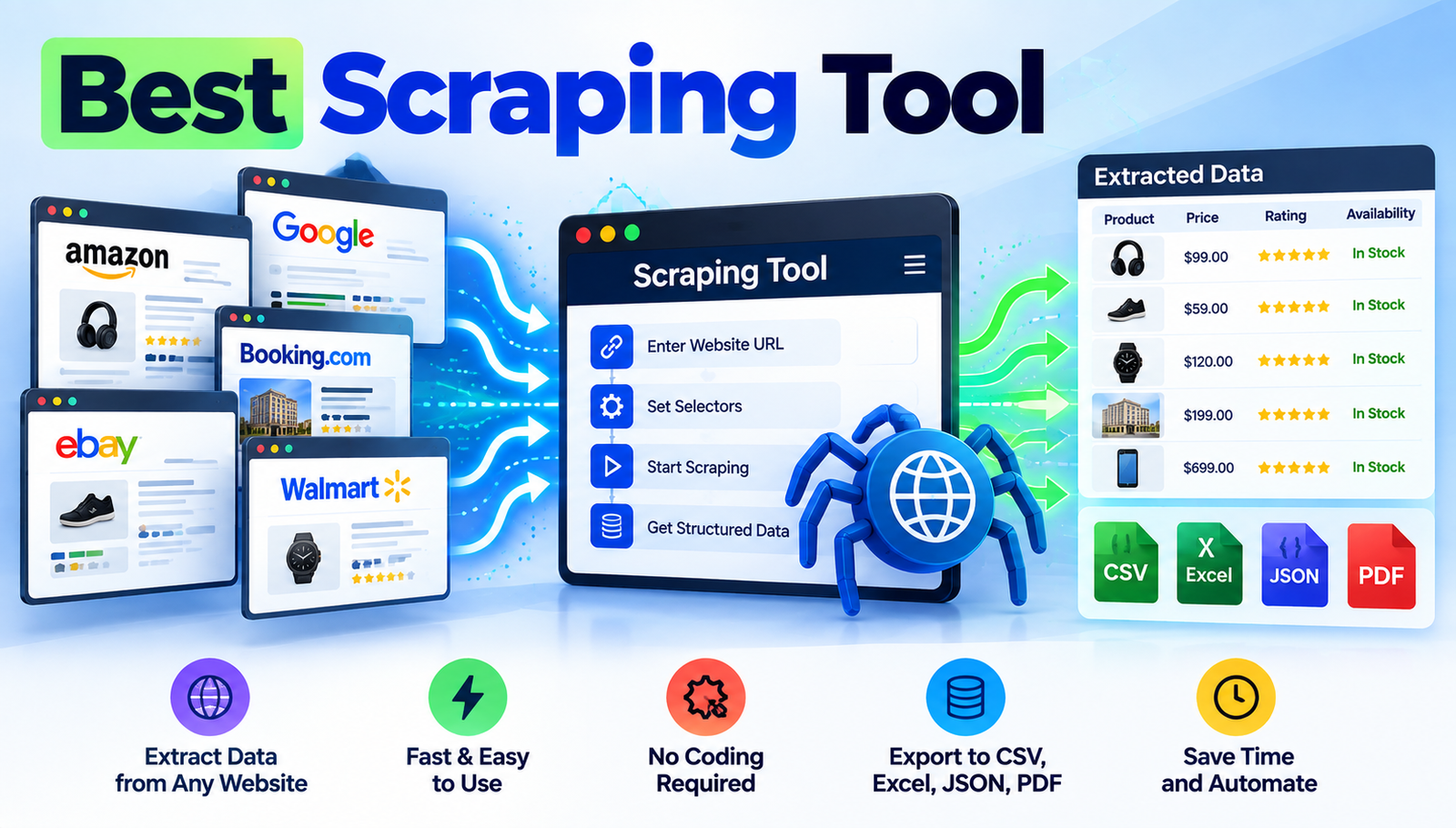
Web Scraping Tool – Extract Website Data Easily Online
Learn how the right scraping tool can turn chaotic web data into clear, actionable insights for better decisions.
Every business that relies on market trends, competitor pricing, or customer sentiment faces a common obstacle: the data lives scattered across countless web pages, PDFs, and APIs, each with its own format and update schedule. Trying to collect that information manually is like gathering seashells on a beach while the tide keeps coming in time‑consuming, error‑prone, and impossible to scale. Selecting the right scraping tool matters because it determines whether a company can turn that chaotic sea of information into a steady stream of reliable, structured data that fuels analytics, forecasting, and strategic planning. A poor choice can waste resources, produce inaccurate datasets, and even expose the organization to legal risk, while a well‑matched tool can automate collection, clean the data, and deliver insights faster than a human ever could.
Breaking Down Scraping Tools
Before diving into specific products, it helps to understand the core concepts that underpin any web scraping solution. A scraper a piece of software that visits web pages and extracts information relies on three fundamental steps: fetching (downloading the raw HTML or JSON), parsing (interpreting the structure of the page to locate the needed elements), and exporting (saving the extracted data into a usable format like CSV or a database). Each step can be performed in many ways, and the choice of method influences speed, accuracy, and cost.
Another essential idea is headless browsing (running a web browser without a visible window) which mimics a real user’s interaction, allowing the scraper to handle dynamic content rendered by JavaScript. Some tools also provide API wrappers pre‑built functions that let developers call a service directly instead of writing their own scraping logic. Understanding these building blocks fetching methods, parsing techniques, headless vs. API approaches makes it easier to compare options later on.
- Extraction Accuracy
- Higher accuracy reduces manual clean-up and improves downstream analysis.
- Scalability
- Determines whether the tool can handle thousands of pages per day without crashing.
- Ease of Use
- A user-friendly interface shortens the learning curve for non-technical staff.
- Cost Structure
- Understanding licensing and usage fees prevents surprise expenses as usage grows.
Top Scraping Tool Innovations to Know
1. Octoparse
Octoparse offers a visual point‑and‑click interface that lets users design extraction workflows without writing code, making it accessible to marketers and analysts alike.
Why It Works:
- Drag‑and‑drop designer mimics a spreadsheet, simplifying complex selectors.
- Built‑in cloud servers run scrapes 24/7, eliminating local hardware constraints.
- Pre‑configured templates for popular sites speed up setup.
What Needs Work:
- Advanced JavaScript rendering can be slower than dedicated headless browsers.
- Pricing tiers become expensive for high‑volume enterprise needs.
Best for: Teams that need a code‑free solution for medium‑scale projects.
2. Scrapy
Scrapy is an open‑source Python framework that gives developers full control over crawling logic, data pipelines, and storage options.
Why It Works:
- Highly extensible through middleware and plugins.
- Efficient asynchronous networking handles thousands of requests per second.
- Strong community support provides many reusable spiders.
What Needs Work:
- Steeper learning curve for non‑programmers.
- No built‑in graphical UI; debugging requires code familiarity.
Best for: Technical teams building custom, large‑scale crawlers.
3. ParseHub
ParseHub combines a desktop application with cloud execution, allowing users to capture data from sites that rely heavily on JavaScript.
Why It Works:
- Visual selector engine understands dynamic page elements.
- Supports multi‑page navigation and form submission.
- Offers API access for integrating results into other systems.
What Needs Work:
- Desktop client can be resource‑intensive on older machines.
- Export formats limited compared with some enterprise platforms.
Best for: Researchers who need to scrape interactive sites without deep coding.
4. Apify
Apify provides a cloud‑first platform where developers can run JavaScript or Python actors (scraping scripts) on scalable infrastructure.
Why It Works:
- Serverless execution scales automatically with demand.
- Marketplace of ready‑made actors reduces development time.
- Integrated proxy rotation helps avoid IP bans.
What Needs Work:
- Cost can rise quickly with high concurrency.
- Interface may feel abstract for users accustomed to traditional IDEs.
Best for: Companies that need reliable, high‑throughput scraping in the cloud.
5. Data Miner
Data Miner is a browser extension that extracts tables and lists directly from the page you are viewing, ideal for quick, on‑the‑fly data grabs.
Why It Works:
- Instant access from Chrome or Firefox without separate software.
- Simple rule builder works for repetitive manual tasks.
- Free tier sufficient for occasional personal use.
What Needs Work:
- Lacks advanced scheduling or cloud execution.
- Limited handling of pagination beyond a few pages.
Best for: Individuals needing occasional, low‑volume extractions.
Comparison
- Octoparse
- Best For: Non-technical teams
- Difficulty: Easy
- Cost: Mid-range subscription
- Speed: Moderate
- Scrapy
- Best For: Custom large-scale projects
- Difficulty: Hard
- Cost: Free (self-hosted)
- Speed: Fast
- ParseHub
- Best For: Dynamic-site researchers
- Difficulty: Medium
- Cost: Tiered subscription
- Speed: Moderate
- Apify
- Best For: High-throughput cloud needs
- Difficulty: Medium
- Cost: Pay-as-you-go
- Speed: Very fast
- DataMiner
- Best For: Ad-hoc personal tasks
- Difficulty: Very easy
- Cost: Free/low-cost
- Speed: Slow to moderate
How to Choose the Right One
First, define the volume of data that will be collected. If the project involves a few hundred rows per month, a simple browser extension may suffice; if it requires millions of records daily, a cloud‑native platform with auto‑scaling becomes essential. Next, evaluate the technical skill set of the team. Organizations with seasoned developers can use open‑source frameworks like Scrapy to fine‑tune performance, while teams with limited coding experience benefit from visual tools such as Octoparse or ParseHub.
Another decisive factor is the nature of the target websites. Sites that rely heavily on JavaScript, infinite scrolling, or CAPTCHA challenges demand a tool with robust headless browsing and proxy management. Apify and ParseHub excel in these scenarios, whereas pure HTML parsers may fail or return incomplete data.
Consider also the data governance and compliance requirements. Some industries must keep audit trails of where data originated and how it was processed. Tools that provide detailed logs, versioned extracts, and clear IP‑rotation policies help meet those obligations. Octoparse’s cloud logs and Apify’s activity reports are examples of built‑in compliance features.
Finally, align the budget and cost predictability with expected growth. Subscription models with fixed caps are easier to forecast for steady workloads, while pay‑as‑you‑go plans suit seasonal spikes but require careful monitoring to avoid surprise bills. Creating a simple spreadsheet that projects monthly runs against each pricing tier can reveal the most economical path.
In summary, the optimal choice balances data volume, technical expertise, target‑site complexity, compliance needs, and cost. By scoring each tool against these criteria, decision‑makers can arrive at a clear, data‑driven recommendation.
Why This Matters to You
Choosing the right scraping tool reduces the time spent on manual copy‑and‑paste, freeing staff to focus on analysis rather than collection. Accurate, structured data improves the reliability of dashboards, leading to faster, more confident business decisions. Automation lowers operational costs by replacing repetitive labour with scalable processes. A tool that handles dynamic sites ensures that no critical competitor pricing or market trend is missed because of technical limitations.
When data pipelines are reliable, forecasting models gain better input quality, which translates into more precise inventory management and reduced stock‑outs. Legal‑compliant scraping protects the organization from potential lawsuits or penalties associated with unauthorized data collection. Finally, a well‑chosen platform can integrate directly with existing BI (business intelligence) tools, creating a seamless flow from raw web content to actionable insight.
Worth Remembering
Effective scraping starts with a clear understanding of volume, site complexity, and team skill. Matching those factors to a tool’s strengths and cost structure yields the best return on investment. A disciplined selection process turns chaotic web data into a strategic asset for smarter decision‑making.
Contact
Missing something?
Feel free to request missing tools or give some feedback using our contact form.
Contact Us