03
Packets Per Second vs Bandwidth: Key Differences Explained
Packet‑per‑second limits and bandwidth limits sound alike but govern network performance in very different ways.
Imagine a mid‑size e‑commerce site in Austin, Texas, that suddenly sees its checkout page stall. The server logs show a flood of 10,000 packets per second, yet the total data transferred is only 2 Mbps. The shop loses sales not because the pipe is full, but because the device can’t process that many packets. This scenario illustrates why understanding packet‑per‑second (PPS) limits versus bandwidth limits matters for anyone managing modern networks.
Breaking Down Packet‑per‑Second Limits and Bandwidth Limits
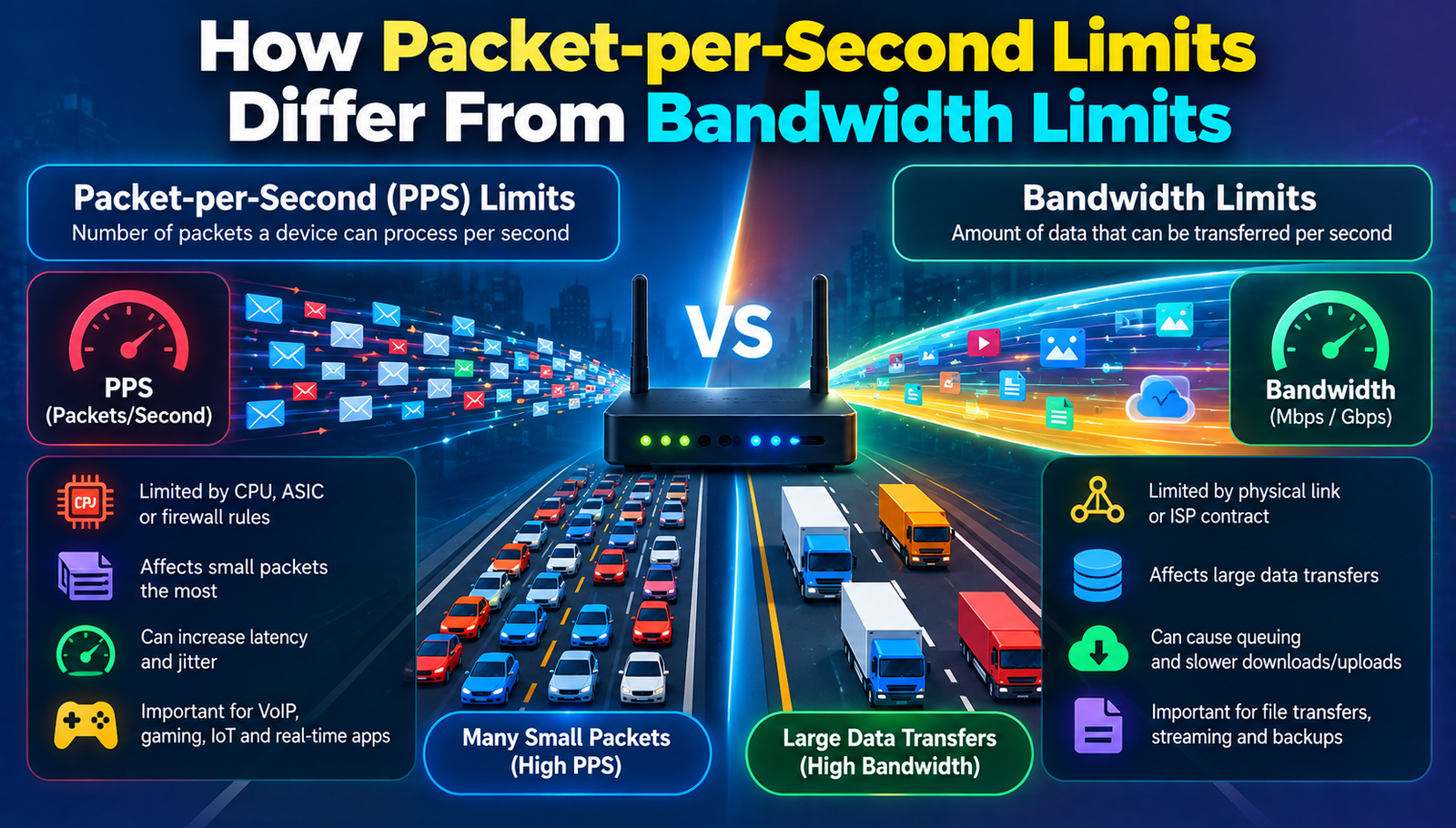
Packet‑per‑second limits refer to the maximum number of packets a network device router, firewall, or switch can inspect, forward, or drop each second. The constraint is often tied to CPU cycles, ASIC processing capacity, or software‑defined rules. In contrast, bandwidth limits measure the total volume of data, usually in bits per second (bps), that can flow through a link. Bandwidth is about the size of the pipe; PPS is about how many droplets can be handled.
Both metrics are crucial, but they affect performance in distinct ways. A link with 1 Gbps capacity can still choke if a firewall can only process 200 kpps, while a 10 Mbps link can feel sluggish if a DDoS attack sends millions of tiny packets that exceed the device’s PPS threshold.
- Packet-per-Second Limit
- Units: pps (or kpps, Mpps)
- Typical Bottleneck: CPU, ASIC, firewall rule set
- Impact on Traffic: Drops or delays small packets, even at low bandwidth
- Bandwidth Limit
- Units: bps (Mbps, Gbps)
- Typical Bottleneck: Physical link, ISP contract
- Impact on Traffic: Queues large flows and affects bulk transfers
- Latency Sensitivity
- Units: ms
- Typical Bottleneck: Buffer sizes, queuing
- Impact on Traffic: High PPS can increase jitter even when bandwidth is sufficient
- Typical Use Case
- Units: Not applicable
- Typical Bottleneck: Not applicable
- Impact on Traffic: VoIP, gaming, and IoT often rely more on low-latency packet processing than raw throughput
Leading Packet‑per‑Second and Bandwidth Management Solutions
1. Cisco ASA 5500‑X Series Firewalls
Designed for enterprise perimeter security, the ASA series balances deep packet inspection with high PPS rates.
Its modular ASICs allow up to 2 million pps while supporting up to 10 Gbps of aggregate bandwidth. The device excels in environments where both DDoS mitigation and high‑throughput VPNs coexist.
- Strengths:
- Hardware‑accelerated inspection reduces CPU load.
- Integrated threat intelligence feeds keep signatures up‑to‑date.
- Granular policy control for both PPS and bandwidth.
2. Palo Alto Networks PA‑500 Series
Palo Alto’s next‑gen firewalls focus on application awareness, which inherently demands high PPS processing.
The PA‑5200 can handle 5 million pps and 40 Gbps of traffic, thanks to its dedicated NP‑U (Network Processing Unit). It is popular in data‑center interconnects where micro‑bursts are common.
- Strengths:
- App‑ID engine parses traffic at line rate.
- WildFire sandbox adds zero‑day protection without sacrificing PPS.
- Scalable clustering for multi‑tenant environments.
3. Juniper Networks vSRX Virtual Firewall
For cloud‑native workloads, the vSRX provides virtualized PPS control alongside bandwidth shaping.
Running on KVM or VMware, it can be provisioned with up to 500 kpps and 5 Gbps, making it ideal for hybrid cloud bridges where physical hardware isn’t an option.
- Strengths:
- Elastic scaling via orchestration tools.
- Integrated with Contrail for SD‑WAN scenarios.
- API‑driven policy updates reduce manual configuration errors.
4. Fortinet FortiGate 6000F Series
FortiGate’s flagship models combine FortiASIC processors with a purpose‑built security operating system.
The 6000F can sustain 6 million pps and 120 Gbps of throughput, positioning it for large ISPs and content delivery networks that must handle both massive bandwidth and packet storms.
- Strengths:
- FortiASIC delivers deterministic PPS performance.
- Broad security suite (IPS, AV, web filtering) runs on the same plane.
- Zero‑day protection via FortiGuard updates.
5. Linux Traffic Control (tc) with BPF
On the open‑source side, Linux’s tc tool combined with eBPF programs offers fine‑grained PPS and bandwidth policing without proprietary hardware.
Operators can attach BPF filters that count packets per second and drop excess traffic, while also shaping bandwidth with HTB or fq_codel queues. This approach is popular in edge routers and custom appliances.
- Strengths:
- Highly customizable via kernel‑level code.
- Cost‑effective for small‑to‑medium deployments.
- Community‑driven updates keep security rules current.
What This Means in Practice
✔ Precise DDoS mitigation
By monitoring PPS, security teams can identify volumetric attacks that consume CPU cycles long before bandwidth saturates, enabling faster mitigation.
✔ Better QoS for latency‑sensitive apps
Voice over IP and online gaming benefit from PPS caps that prevent packet bursts from increasing jitter, even on high‑capacity links.
✔ Efficient capacity planning
Understanding both metrics lets engineers size hardware correctly avoiding over‑paying for bandwidth that never gets used because PPS is the real bottleneck.
✔ Accurate billing and SLA enforcement
Service providers can draft contracts that differentiate between data volume and packet rate, reducing disputes over perceived “slow” connections.
✔ Streamlined troubleshooting
When an outage occurs, checking PPS counters first often reveals misbehaving devices before digging into link utilization graphs.
✔ Optimized security rule sets
Complex ACLs increase per‑packet processing time; simplifying rules improves PPS capacity without touching bandwidth.
What's Coming
- AI‑driven PPS prediction models will anticipate traffic spikes before they happen, allowing pre‑emptive scaling.
Machine learning will ingest historical packet traces to forecast micro‑burst patterns, reducing false positives in DDoS alerts.
- Integrated silicon that merges PPS inspection with quantum‑resistant encryption.
Next‑gen ASICs will decrypt traffic at line rate while still counting packets, addressing future security mandates.
- Edge‑compute platforms offering per‑packet telemetry as a service.
Providers will expose PPS metrics via standardized APIs, enabling multi‑cloud orchestration tools to balance load dynamically.
- Hybrid SLA frameworks that bill separately for bandwidth and PPS usage.
Enterprises will negotiate contracts where a burst of 1 million pps costs a premium, but steady 100 Mbps traffic remains at base rate.
- Standardized PPS benchmarks across vendors.
Industry groups will publish uniform test suites, making it easier to compare firewalls and routers on true packet processing capability.
- Cisco ASA 5500-X
- Max PPS: 2 Mpps
- Max Bandwidth: 10 Gbps
- Typical Deployment: Enterprise edge
- Palo Alto PA-5200
- Max PPS: 5 Mpps
- Max Bandwidth: 40 Gbps
- Typical Deployment: Data-center core
- Juniper vSRX
- Max PPS: 0.5 Mpps
- Max Bandwidth: 5 Gbps
- Typical Deployment: Cloud-native edge
- Fortinet 6000F
- Max PPS: 6 Mpps
- Max Bandwidth: 120 Gbps
- Typical Deployment: ISP backbone
What It All Means
Packet‑per‑second limits and bandwidth limits govern two orthogonal dimensions of network performance. Recognizing their differences empowers engineers to choose the right hardware, craft accurate SLAs, and troubleshoot issues before they affect users. As networks grow more complex, balancing PPS and bandwidth will remain a cornerstone of reliable, secure connectivity.
Contact
Missing something?
Feel free to request missing tools or give some feedback using our contact form.
Contact Us