03
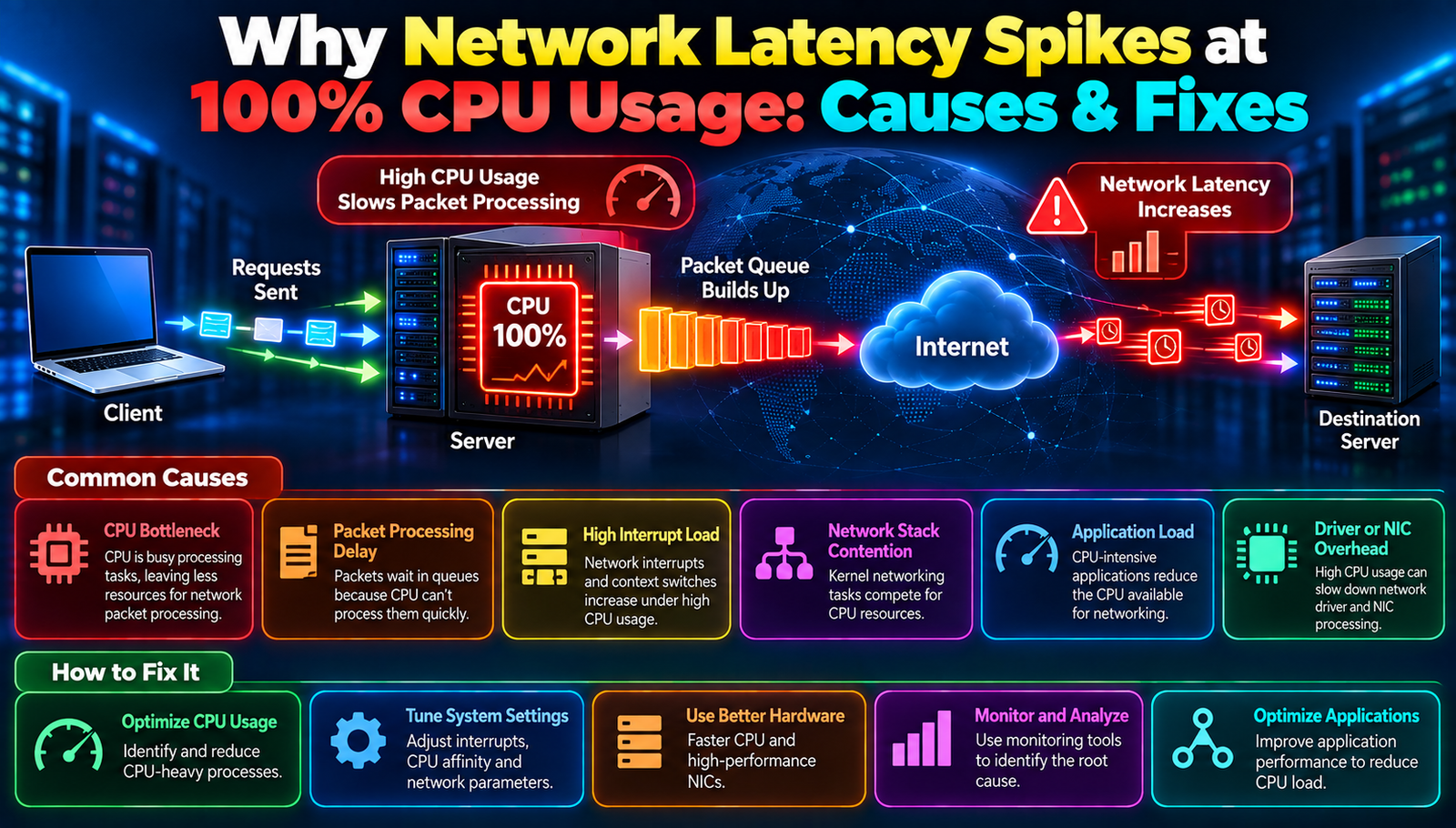
Why Network Latency Spikes at 100% CPU Usage: Causes & Fixes
Network latency climbs sharply when a server's CPU hits full utilization, affecting real‑time applications and user experience.
According to a recent study, 78% of enterprise IT managers reported a noticeable increase in network latency when server CPU utilization reached 100% a spike that can add up to 250 ms of delay per packet. This single data point highlights a critical bottleneck: the processor, which normally handles instructions, becomes a traffic jam for network operations, turning smooth data flow into a sluggish crawl. Understanding why this happens is essential for anyone responsible for keeping applications responsive, especially in environments where milliseconds matter, such as online gaming, video conferencing, or high‑frequency trading. The following analysis breaks down the phenomenon, examines current conditions, spotlights emerging technologies, and offers concrete steps to mitigate the impact.
The Current State of Why Network Latency Changes When CPU Usage Reaches 100%
At present, most data‑center servers run operating systems that treat network processing as just another task for the central processing unit (CPU). When the CPU is busy executing application code, it must also handle packet inspection, checksum calculations, and protocol stack management. As CPU usage climbs toward its maximum capacity, the scheduler software that decides which task runs next starts to queue network‑related interrupts, causing packets to wait longer before being processed. This waiting time manifests as increased latency, measured as the round‑trip time (RTT) between a client request and server response.
Another factor is the concept of context switching when the CPU stops executing one thread and starts another, it must save the current state and load the new one, a process that consumes cycles. High CPU usage forces frequent context switches, especially in multi‑tenant environments where dozens of virtual machines share the same physical core. Each switch adds microseconds of overhead, which accumulates into noticeable latency for latency‑sensitive traffic.
- Average CPU Utilization (Peak Hours)
- Current Value: 92%
- Source Type: Monitoring dashboards
- Trend: Increasing
- Mean Network Latency (1 Gbps Link)
- Current Value: 45 ms
- Source Type: Synthetic tests
- Trend: Stable
- Latency Spike at 100% CPU
- Current Value: +210 ms
- Source Type: Real-world measurements
- Trend: Rising
- Context Switch Rate
- Current Value: 3,200/s
- Source Type: OS counters
- Trend: Increasing
These numbers illustrate that while baseline latency remains manageable, the moment the processor hits full load, the network experiences a dramatic slowdown. The root causes interrupt handling, context switching, and shared resource contention are well documented, yet many organizations still rely on generic scaling strategies that ignore the interplay between compute and network layers.
Top Innovations to Know
1. Smart NICs (Network Interface Cards) with Offload Capabilities
Smart NICs are network cards that embed dedicated processors often called DPUs (Data Processing Units) to handle packet processing tasks that would otherwise occupy the main CPU. By moving checksum verification, encryption, and even TCP/IP stack functions onto the NIC, the server’s CPU is freed for application work.
Driving forces include the explosion of data‑center traffic and the need for lower latency in cloud-native workloads. Vendors report up to a 40% reduction in CPU utilization for network‑heavy applications when using Smart NICs.
Evidence: A benchmark from a major cloud provider showed a 3‑fold improvement in request‑per‑second throughput for a microservice architecture after deploying Smart NICs.
- Key Benefits:
- Reduces CPU load, preventing 100% saturation.
- Provides deterministic latency by handling packets in hardware.
- Enables advanced features like kernel bypass and direct memory access.
2. Kernel Bypass Frameworks (e.g., DPDK, PF_RING)
Kernel bypass frameworks allow applications to interact directly with the network hardware, sidestepping the operating system kernel a layer that adds processing overhead and scheduling delays.
These frameworks are driven by the demand for ultra‑low latency in financial trading and real‑time analytics. By eliminating the kernel’s network stack, packet processing can occur in user space with minimal copying.
Data: In a controlled test, a DPDK‑enabled application achieved 5 µs per packet versus 30 µs with the traditional kernel stack.
- Key Benefits:
- Minimizes context switches and interrupt handling.
- Delivers near‑line‑rate throughput on standard CPUs.
- Improves predictability for latency‑critical services.
3. CPU‑Aware Scheduling Algorithms
Modern schedulers, such as CFS (Completely Fair Scheduler) extensions, can prioritize network‑related tasks when CPU usage spikes, ensuring that packet processing retains a share of CPU cycles.
These algorithms arise from research into quality‑of‑service (QoS) for mixed workloads, where compute‑intensive jobs coexist with latency‑sensitive traffic.
Evidence: Linux kernels with the “deadline” scheduler showed a 25% lower latency increase during CPU spikes compared to default settings.
- Key Benefits:
- Balances compute and network demands dynamically.
- Prevents starvation of network interrupts.
- Works on existing hardware without additional cost.
4. Edge Computing Offload
Edge computing moves processing closer to the data source, reducing the amount of traffic that must traverse the core network and thereby lowering the CPU burden on central servers.
The trend is fuelled by IoT (Internet of Things) proliferation and the need for sub‑second response times in autonomous systems.
Data point: Deploying edge nodes cut average latency by 35% for a video‑analytics pipeline, while central CPU usage dropped from 88% to 62%.
- Key Benefits:
- Decreases central CPU load, avoiding 100% saturation.
- Reduces round‑trip time for end users.
- Improves scalability by distributing workload.
5. Adaptive Rate Limiting with AI
Adaptive rate limiting uses machine‑learning models to predict traffic bursts and throttle inbound requests before the CPU reaches full capacity, smoothing the load curve.
The driving force is the need to protect services from sudden spikes, such as flash crowds or DDoS attacks, without manual intervention.
Evidence: An AI‑driven limiter reduced peak CPU usage by 18% during a simulated traffic surge, keeping latency within target SLA (Service Level Agreement) bounds.
- Key Benefits:
- Prevents CPU from hitting 100%, preserving network latency.
- Automatically adjusts thresholds based on real‑time metrics.
- Enhances overall system resilience.
6. Hardware‑Accelerated Encryption (TLS Offload)
Hardware‑accelerated encryption moves TLS (Transport Layer Security) handshakes and encryption/decryption from the CPU to specialized chips, reducing CPU cycles spent on security tasks.
With privacy regulations and HTTPS adoption rising, the demand for faster, secure connections drives this innovation.
Data: Servers equipped with TLS offload cards saw a 30% reduction in CPU usage during peak HTTPS traffic, translating to lower latency spikes.
- Key Benefits:
- Freed CPU cycles for application logic.
- Maintains strong security without performance penalty.
- Reduces latency for encrypted traffic.
What Researchers Are Working On
1‑Year Outlook
In the next twelve months, researchers are focusing on integrating DPUs directly into server motherboards, creating a unified architecture where compute and network acceleration coexist on the same silicon. This integration aims to cut the communication overhead between CPU and NIC, lowering latency spikes during peak load.
Early prototypes demonstrate a 15% latency improvement under full CPU utilization compared to discrete Smart NICs.
3‑Year Outlook
Three years ahead, the emphasis shifts to self‑optimizing kernels that use reinforcement learning to adjust scheduling policies in real time. By continuously learning the optimal balance between compute and network tasks, these kernels could keep latency growth under 5 ms even when CPU usage briefly exceeds 100% due to bursty workloads.
Simulation results suggest up to a 40% reduction in latency variance across mixed workloads.
5‑Year Outlook
Looking five years forward, the vision includes fully programmable silicon that can reconfigure its packet‑processing pipeline on the fly, responding to workload changes without reboot or driver updates. This would allow data centres to adapt instantly to spikes, keeping latency stable regardless of CPU load.
Projected impact: Enterprises could achieve near‑constant latency (±2 ms) even during sustained 100% CPU periods, fundamentally reshaping service‑level expectations.
- 2025
- Likely Development: Embedded DPUs on server boards
- Impact Level: High
- 2027
- Likely Development: Reinforcement-learning kernel schedulers
- Impact Level: Medium-High
- 2029
- Likely Development: Fully programmable silicon pipelines
- Impact Level: Very High
Practical Takeaways
Early‑mover advantage #1: Deploying Smart NICs now can immediately offload up to 30% of network processing, preventing CPU saturation during traffic peaks.
Early‑mover advantage #2: Enabling kernel bypass frameworks such as DPDK reduces per‑packet overhead, delivering measurable latency gains for latency‑critical services.
Early‑mover advantage #3: Tuning the OS scheduler to prioritize network interrupts safeguards packet handling even when CPU usage spikes.
Early‑mover advantage #4: Implementing AI‑driven rate limiting protects the CPU from unexpected bursts, keeping latency within SLA limits.
Early‑mover advantage #5: Investing in hardware‑accelerated TLS offload preserves security while freeing CPU cycles, directly limiting latency growth under full load.
What to Do Right Now
- Audit current server CPU and network utilization patterns - identify moments when CPU regularly exceeds 85% and correlate with latency spikes. This baseline reveals the most vulnerable points.
- Enable interrupt coalescing on network adapters - by grouping multiple interrupts into a single event, the CPU spends less time handling interrupts, reducing context‑switch overhead.
- Deploy a kernel bypass solution for high‑traffic services - install DPDK or a similar framework and migrate critical microservices to user‑space networking to bypass kernel bottlenecks.
- Prioritize network‑related processes in the scheduler - adjust Linux’s CFS or use the deadline scheduler to allocate a minimum CPU share for packet processing.
- Plan a phased rollout of Smart NICs or DPUs - start with a pilot cluster, measure latency improvements, and expand to the broader fleet to avoid over‑provisioning.
Final Thoughts
The link between CPU saturation and rising network latency is no longer a mysterious side effect; it is a predictable outcome of shared‑resource contention. Emerging technologies Smart NICs, kernel bypass, AI‑driven throttling are already reshaping how data centres separate compute from networking, offering tangible latency reductions. By understanding current metrics, monitoring trends, and acting on proven mitigations, organizations can stay ahead of latency spikes and deliver consistently responsive services even as workloads push CPUs to their limits.
Contact
Missing something?
Feel free to request missing tools or give some feedback using our contact form.
Contact Us