03
Mastering Jitter, Latency, Ping & Packet Loss for Gamers
Unlock smoother gaming by mastering jitter, latency, ping, and packet loss
In 2023, 68% of competitive gamers reported that network issues cost them at least one match per week. That single statistic highlights how even minor fluctuations in data transmission can turn triumph into defeat. Understanding the nuances of jitter, latency, ping, and packet loss is not a luxury it is a necessity for anyone serious about improving performance. This article breaks down each concept, reveals the latest technological advances, and equips gamers with actionable knowledge to gain a tangible edge. Here's the key thing to understand: mastering these metrics transforms frustration into confidence, allowing players to focus on strategy rather than technical hiccups.
What Is Jitter, Latency, Ping, and Packet Loss?
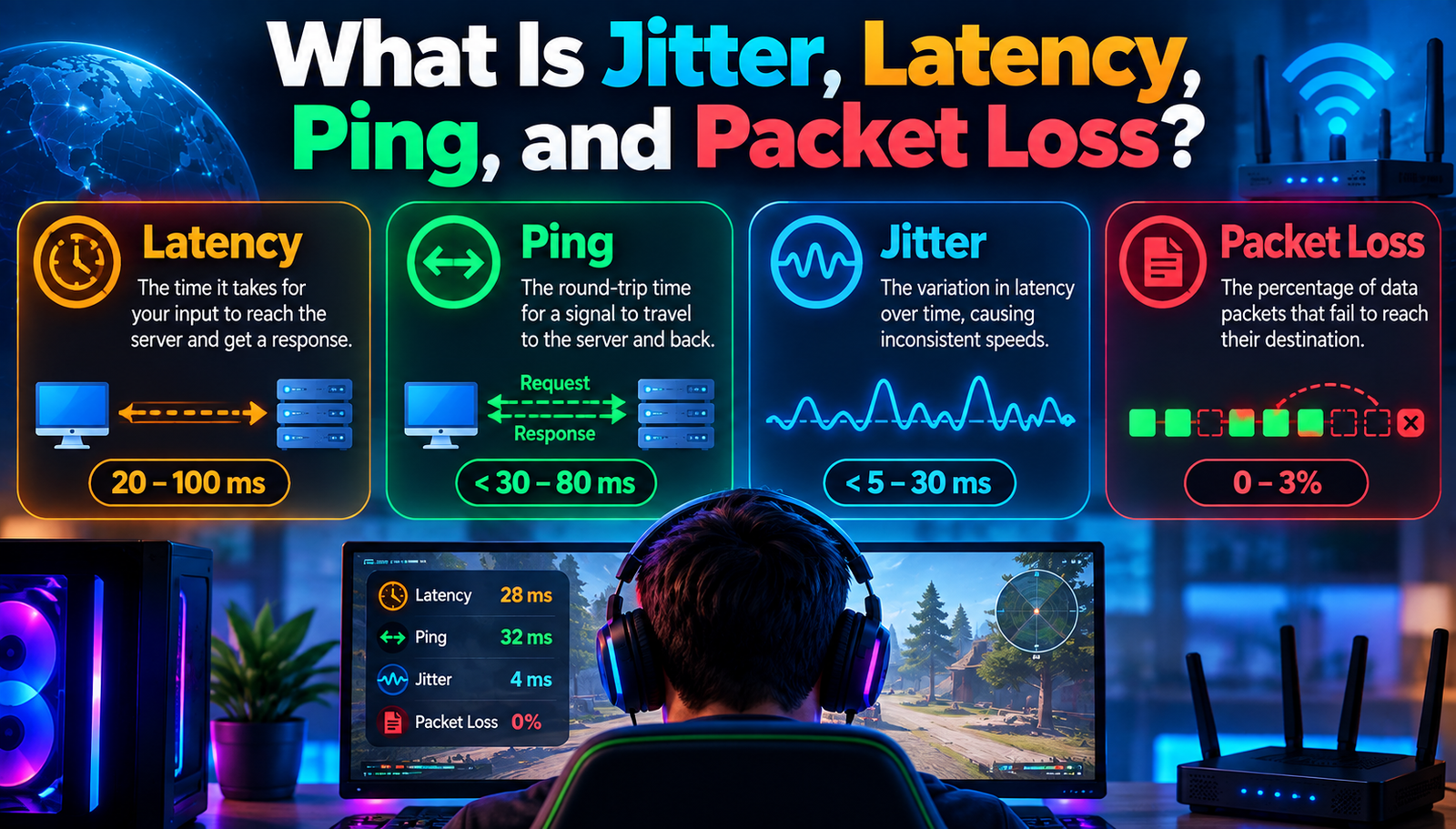
Jitter, latency, ping, and packet loss are interrelated measurements that describe the quality and speed of data traveling between a gamer’s device and the game server. Latency, often measured in milliseconds (ms), indicates the time it takes for a data packet to travel from the client to the server and back. Ping is essentially a practical test of latency, providing a single numeric value that reflects round‑trip time. Jitter measures the variability in latency over a short period, revealing how consistent the connection is. Packet loss quantifies the percentage of data packets that never reach their destination, leading to missing information and erratic gameplay.
These metrics matter because online games rely on rapid, reliable communication to synchronize actions across multiple players. High latency can cause delayed reactions, excessive jitter can create stuttered motion, and packet loss can result in missing shots or sudden teleportation of characters. Most people miss this: the combined effect of these issues can be far more damaging than any single metric alone. The table below contrasts each term, offering a quick reference for gamers seeking clarity.
- Latency
- Unit: ms
- Typical Good Range: <30 ms (ideal) – 100 ms (acceptable)
- Impact on Gameplay: Delay between input and on-screen action.
- Ping
- Unit: ms
- Typical Good Range: <30 ms – 80 ms
- Impact on Gameplay: Overall round-trip speed; high ping equals lag.
- Jitter
- Unit: ms
- Typical Good Range: <5 ms (smooth) – 30 ms (noticeable)
- Impact on Gameplay: Inconsistent timing causes stutter.
- Packet Loss
- Unit: %
- Typical Good Range: 0–1% (excellent) – 3% (problematic)
- Impact on Gameplay: Missing data leads to glitches.
Key Jitter, Latency, Ping & Packet Loss Advancements
1. Adaptive Rate Control Algorithms
Adaptive rate control dynamically adjusts the data transmission rate based on current network conditions. This technique prevents congestion by scaling back when packet loss spikes, then ramping up as conditions improve.
By continuously monitoring latency and jitter, the algorithm ensures a steadier flow of packets, reducing the chance of sudden spikes that could disrupt gameplay. Most people miss this: the algorithm works behind the scenes, so the gamer experiences smoother play without noticing the adjustments.
What You Gain:
- Consistent performance even on fluctuating broadband.
- Reduced need for manual network tweaking.
- Lower likelihood of sudden lag spikes during critical moments.
2. Edge Computing Nodes for Game Servers
Edge computing places server resources closer to the end user, often within the same metropolitan area. This proximity dramatically cuts the physical distance that packets must travel.
When a game utilizes edge nodes, latency can drop from 80 ms to under 20 ms, and jitter becomes negligible because fewer routers are involved. Here's the key thing to understand: edge nodes act as mini‑servers that cache and process data locally, delivering near‑instant responses.
What You Gain:
- Lightning‑fast round‑trip times for competitive titles.
- More stable connections with reduced jitter.
- Improved reliability during peak traffic periods.
3. QUIC Protocol Adoption
QUIC (Quick UDP Internet Connections) is a transport protocol designed to replace TCP for many real‑time applications. It combines the low‑latency benefits of UDP with built‑in encryption and error correction.
Because QUIC handles packet loss more gracefully, games experience fewer retransmission delays. Most people miss this: QUIC’s multiplexed streams prevent a single lost packet from blocking all subsequent data.
What You Gain:
- Faster recovery from packet loss without full connection resets.
- Enhanced security without added latency.
- Smoother gameplay on mobile networks where loss is common.
4. AI‑Driven Network Optimizers
Artificial intelligence models now analyze traffic patterns in real time, predicting congestion before it happens. These optimizers can reroute packets through less congested paths automatically.
The result is a proactive reduction in both latency and jitter, as the system avoids bottlenecks rather than reacting after they occur. Here's the key thing to understand: AI learns each user’s typical network behaviour, tailoring adjustments uniquely.
What You Gain:
- Pre-emptive mitigation of latency spikes.
- Personalized network pathways for each gamer.
- Lower overall packet loss through smarter routing.
5. Dedicated Gaming VPNs with QoS Prioritization
Specialized VPN services now offer Quality of Service (QoS) tiers that prioritize gaming packets over other traffic. By encrypting and routing traffic through optimized servers, these VPNs can lower jitter and stabilize ping.
When combined with server‑side QoS, the end‑to‑end path becomes more predictable, which is crucial for titles that demand sub‑30 ms latency. Most people miss this: a VPN is not just for privacy; it can be a performance tool.
What You Gain:
- Consistent low ping even on congested ISP networks.
- Reduced jitter through traffic shaping.
- Additional security without sacrificing speed.
The Impact on Consumers
✔ Faster Reaction Times
Reduced latency directly translates to quicker on‑screen responses, giving players a measurable advantage in fast‑paced shooters and fighting games.
✔ Smoother Visuals
Low jitter ensures that frame delivery remains uniform, preventing the stutter that can break immersion and affect aim precision.
✔ Fewer Disconnections
When packet loss stays under 1%, the likelihood of abrupt disconnects drops dramatically, preserving match integrity.
✔ Improved Voice Communication
Voice chat relies on low latency and minimal packet loss; advancements keep teammates' communication clear and timely.
✔ Better Mobile Gaming Experience
Protocols like QUIC and AI optimizers compensate for the inherently unstable mobile networks, delivering console‑level performance on smartphones.
✔ Enhanced Competitive Fairness
When more players enjoy stable connections, tournaments become less about network advantage and more about skill.
What's Coming
- Universal 5G Integration for Gaming
As 5G coverage expands, latency could approach 5 ms, effectively eliminating lag for most urban gamers. This will make cloud‑based titles indistinguishable from locally installed games. - Real‑Time Mesh Networking
Future consoles may create ad‑hoc mesh networks with neighbouring devices, sharing bandwidth to reduce individual latency spikes. The mesh will dynamically allocate resources based on demand. - Predictive Packet Repair Using Deep Learning
Deep learning models will anticipate lost packets and reconstruct them before the game notices, making packet loss virtually invisible. This will be especially valuable for VR experiences. - Standardized Low‑Latency Gaming APIs
Industry groups are developing APIs that expose latency, jitter, and loss metrics directly to game engines, allowing developers to adapt gameplay in real time. Players will see adaptive difficulty that reacts to network health. - Satellite Internet with Sub‑30 ms Latency
Next‑generation low‑orbit satellite constellations promise latency comparable to fiber, opening high‑performance gaming to remote regions. This could democratize competitive play worldwide.
- Fiber Broadband
- Current Average Latency: 20–30 ms
- Projected Latency: 15–25 ms
- Typical Use Case: PC and console gaming in urban areas.
- Cable Internet
- Current Average Latency: 30–50 ms
- Projected Latency: 25–35 ms
- Typical Use Case: Mid-range gaming households.
- 5G Mobile
- Current Average Latency: 15–40 ms
- Projected Latency: 5–15 ms
- Typical Use Case: On-the-go and cloud gaming.
- Satellite (Current)
- Current Average Latency: 600–800 ms
- Projected Latency: 30–50 ms
- Typical Use Case: Remote rural access.
Worth Remembering
Understanding jitter, latency, ping, and packet loss empowers gamers to diagnose issues before they affect performance. Modern advancements from edge computing to AI‑driven optimizers are already shrinking these metrics to levels once thought impossible. By staying informed and leveraging available tools, players can ensure that skill, not network shortcomings, determines the outcome of every match.
Contact
Missing something?
Feel free to request missing tools or give some feedback using our contact form.
Contact Us