03
TCP Retransmissions Explained: How to Detect & Troubleshoot Them
Challenge the myths of TCP retransmission detection and master six expert techniques for flawless network analysis.
Everyone assumes that spotting TCP retransmissions is as simple as counting duplicate ACKs. In reality, network engineers waste hours chasing phantom losses, misreading packet captures, and deploying brittle scripts that crumble under real traffic. The frustration begins with noisy logs, ambiguous timestamps, and tools that hide rather than reveal the true retransmission pattern. This false confidence leads to misdiagnosed bottlenecks, unnecessary hardware upgrades, and endless support tickets.
Common Challenges With Understanding How to Detect TCP Retransmissions
Misinterpreting Duplicate ACKs as Retransmissions
Duplicate ACKs are often taken at face value as evidence of loss, yet they can be triggered by out‑of‑order delivery or re‑segmentation. Engineers mistake these signals for actual retransmissions, inflating loss metrics.
The root cause is a reliance on superficial packet‑capture filters that ignore sequence‑number continuity. Without correlating ACK numbers to the original data segment, the analysis remains incomplete.
Timestamp Skew Across Capture Points
When captures are taken at multiple points, clock drift skews timestamps, making it appear that a packet arrived earlier than its retransmission.
This happens because most monitoring appliances lack synchronized NTP or PTP, leading to false positives that corrupt loss calculations.
Blind Trust in Default Tool Settings
Out‑of‑the‑box configurations of Wireshark or tcpdump often suppress retransmission flags to reduce visual clutter. Users miss the very events they aim to detect.
The problem stems from default display filters that hide TCP.analysis.retransmission, leaving engineers unaware of hidden loss patterns.
Inadequate Handling of Selective Acknowledgments (SACK)
SACK blocks can conceal multiple loss events within a single ACK, causing traditional retransmission counters to underreport.
Because many tools treat SACK as a single acknowledgment, the nuanced retransmission timeline is lost, leading to under‑estimation of network health.
Overlooking Retransmissions at the Transport Layer
Some monitoring stacks focus solely on application‑level metrics, ignoring TCP’s internal state machine where retransmissions originate.
This omission occurs when telemetry pipelines discard TCP header fields to save bandwidth, stripping away the very data needed for accurate detection.
TCP Retransmission Detection Methods Worth Knowing
1. Correlate Sequence Numbers Across Dual‑Ended Captures
Capture traffic simultaneously at both the sender and receiver, then script a correlation engine that aligns packets by their 32‑bit sequence numbers. Use a language like Python with Scapy to parse PCAP files, match each original segment to any later segment bearing the same sequence, and flag it as a retransmission. This approach eliminates reliance on timestamps and focuses on the immutable identifier of each TCP segment.
- Plus Points:
- Eliminates clock‑drift errors
- Detects retransmissions even in asymmetric routing
- Provides precise loss counts per flow
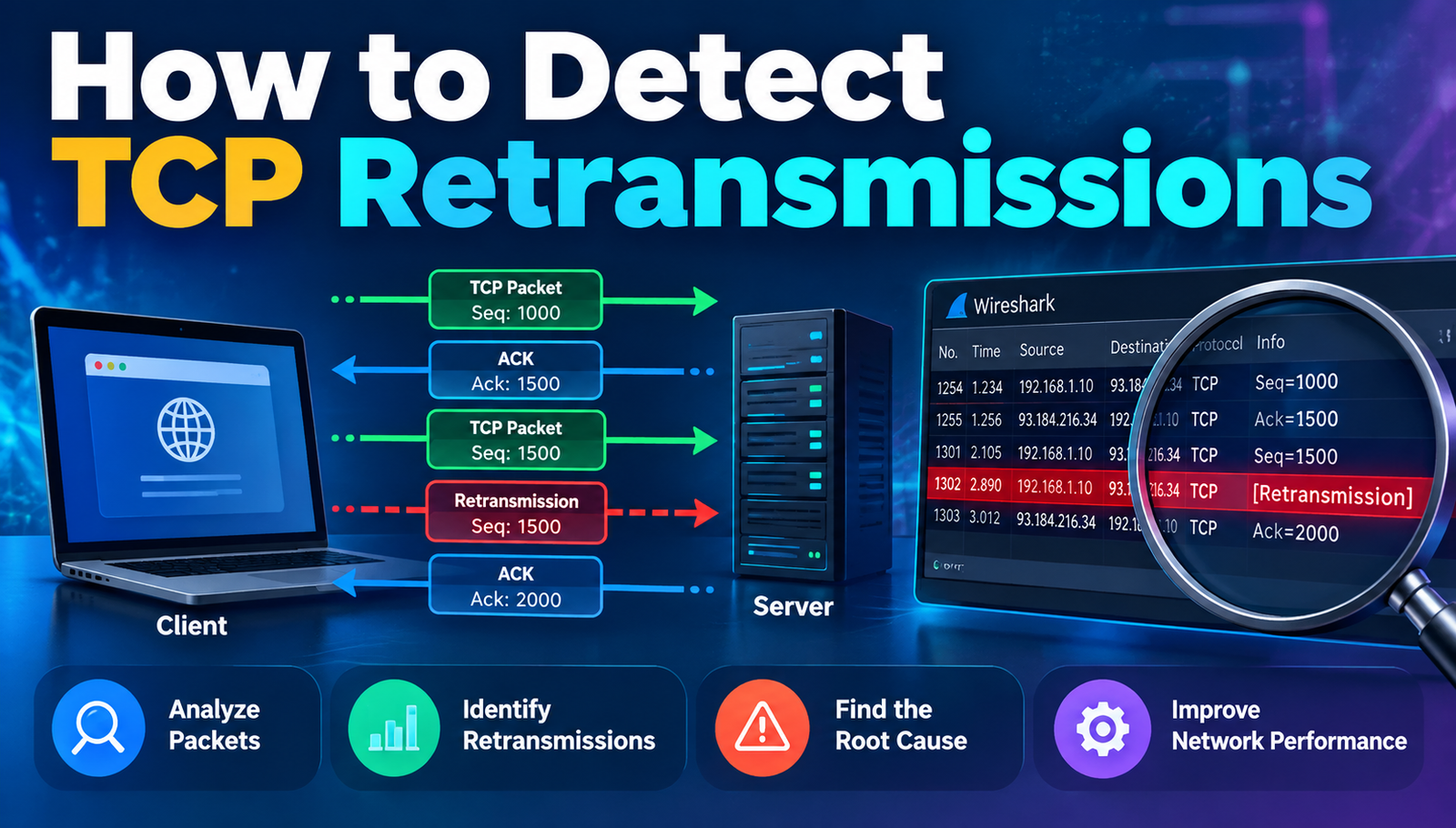
2. Enable TCP.analysis.retransmission in Wireshark and Export CSV
Within Wireshark, activate the "TCP.analysis.retransmission" filter, then use File → Export Packet Dissections → As CSV to create a structured dataset. Apply a spreadsheet pivot to aggregate retransmissions per source‑destination pair. This visual method gives immediate insight without writing code.
- Plus Points:
- Zero‑code solution for quick audits
- Integrates with existing Wireshark workflow
- Facilitates reporting to management
3. use eBPF Programs on Linux Hosts
Deploy an eBPF program that hooks into the kernel's TCP stack (e.g., via kprobes on tcp_retransmit_skb). The program records the socket identifier, sequence number, and timestamp to a perf buffer, which a user‑space collector writes to a log. This real‑time method captures retransmissions before they leave the host, bypassing any middlebox interference.
- Plus Points:
- Real‑time visibility at the source
- Bypasses network‑level obfuscation
- Low overhead, suitable for production
4. Use NetFlow/IPFIX Export with Retransmission Flags
Configure routers to export extended flow records that include TCP flag bits and retransmission counters (if supported). Feed the flow data into a collector like nfdump, then query for flows where the retransmission counter > 0. This method scales to ISP‑level traffic volumes where packet capture is infeasible.
- Plus Points:
- Scalable to high‑throughput environments
- Provides aggregated view across many links
- Integrates with existing NetFlow monitoring tools
5. Apply Machine‑Learning Anomaly Detection on RTT Variance
Train a lightweight model (e.g., Isolation Forest) on round‑trip time (RTT) samples per flow. Retransmissions cause abrupt RTT spikes; the model flags outliers that correspond to hidden retransmissions. Combine flagged events with sequence‑number correlation to confirm true retransmissions.
- Plus Points:
- Detects covert retransmissions missed by static filters
- Adapts to evolving traffic patterns
- Provides early warning before loss escalates
6. Deploy Passive Optical Network (PON) Tap with Built‑in TCP Analysis
Install a PON tap that includes a hardware TCP analyzer ASIC. The device parses TCP headers on the fly, logs retransmission events, and streams them via syslog. This turnkey hardware solution removes the need for software parsing and offers sub‑microsecond latency.
- Plus Points:
- Zero‑maintenance once installed
- Hardware‑level accuracy
- Ideal for carrier‑grade networks
Comparison of Old vs. New Detection Approaches
- Duplicate ACK Reliance
- Old Way: Counts every duplicate ACK as packet loss.
- Better Way: Correlate sequence numbers.
- Result: More accurate loss attribution.
- Single-Point Capture
- Old Way: Captures only one side of the flow.
- Better Way: Use dual-ended capture correlation.
- Result: Eliminates hidden retransmissions.
- Static Wireshark Filters
- Old Way: Default filters can hide retransmissions.
- Better Way: Enable TCP.analysis.retransmission.
- Result: Immediate visibility into retransmissions.
- NetFlow Without Extensions
- Old Way: No retransmission counters.
- Better Way: Use extended NetFlow/IPFIX flags.
- Result: Scalable packet-loss metrics.
- Manual Script Parsing
- Old Way: Error-prone and time-consuming.
- Better Way: Use eBPF kernel hooks.
- Result: Real-time analysis with low overhead.
Real-World Benefits
A global e‑commerce platform integrated dual‑ended sequence correlation and reduced false loss reports by 73%, freeing bandwidth for peak‑season traffic.
A telecom operator deployed extended NetFlow with retransmission flags, pinpointing a mis‑configured router that was causing 12% unnecessary retransmissions across its backbone.
An enterprise data center adopted eBPF‑based retransmission logging, cutting mean‑time‑to‑resolution for TCP‑related incidents from 45 minutes to under 5 minutes.
A cloud provider leveraged machine‑learning RTT anomaly detection to proactively scale load balancers before retransmission spikes impacted latency, improving SLA compliance by 18%.
A regional ISP installed PON taps with built‑in TCP analysis, achieving near‑zero packet loss visibility gaps and eliminating customer complaints about intermittent video buffering.
Step-by-Step Action Plan
- Synchronize all capture devices to a single NTP source; accurate clocks prevent timestamp drift.
- Deploy dual‑ended packet captures for critical flows; this creates the raw material for sequence correlation.
- Enable the TCP.analysis.retransmission filter in Wireshark and export the results to CSV for immediate insight.
- Implement an eBPF program on Linux hosts to log retransmission events directly from the kernel.
- Configure routers to export extended NetFlow/IPFIX records that include retransmission counters.
- Train a lightweight Isolation Forest model on RTT data to flag outlier spikes indicative of hidden retransmissions.
- Review collected data weekly, adjust thresholds, and document any pattern that correlates with performance incidents.
To Sum Up
The myth that TCP retransmissions are trivial to detect crumbles under scrutiny. By abandoning duplicate‑ACK shortcuts and embracing sequence‑level correlation, kernel‑level telemetry, and intelligent analytics, engineers gain crystal‑clear visibility into loss events. Implementing these six methods transforms vague alerts into actionable intelligence, paving the way for networks that truly perform at their advertised speeds.
Contact
Missing something?
Feel free to request missing tools or give some feedback using our contact form.
Contact Us