03
IPv6 Routing Explained: Different Paths, Performance & Privacy
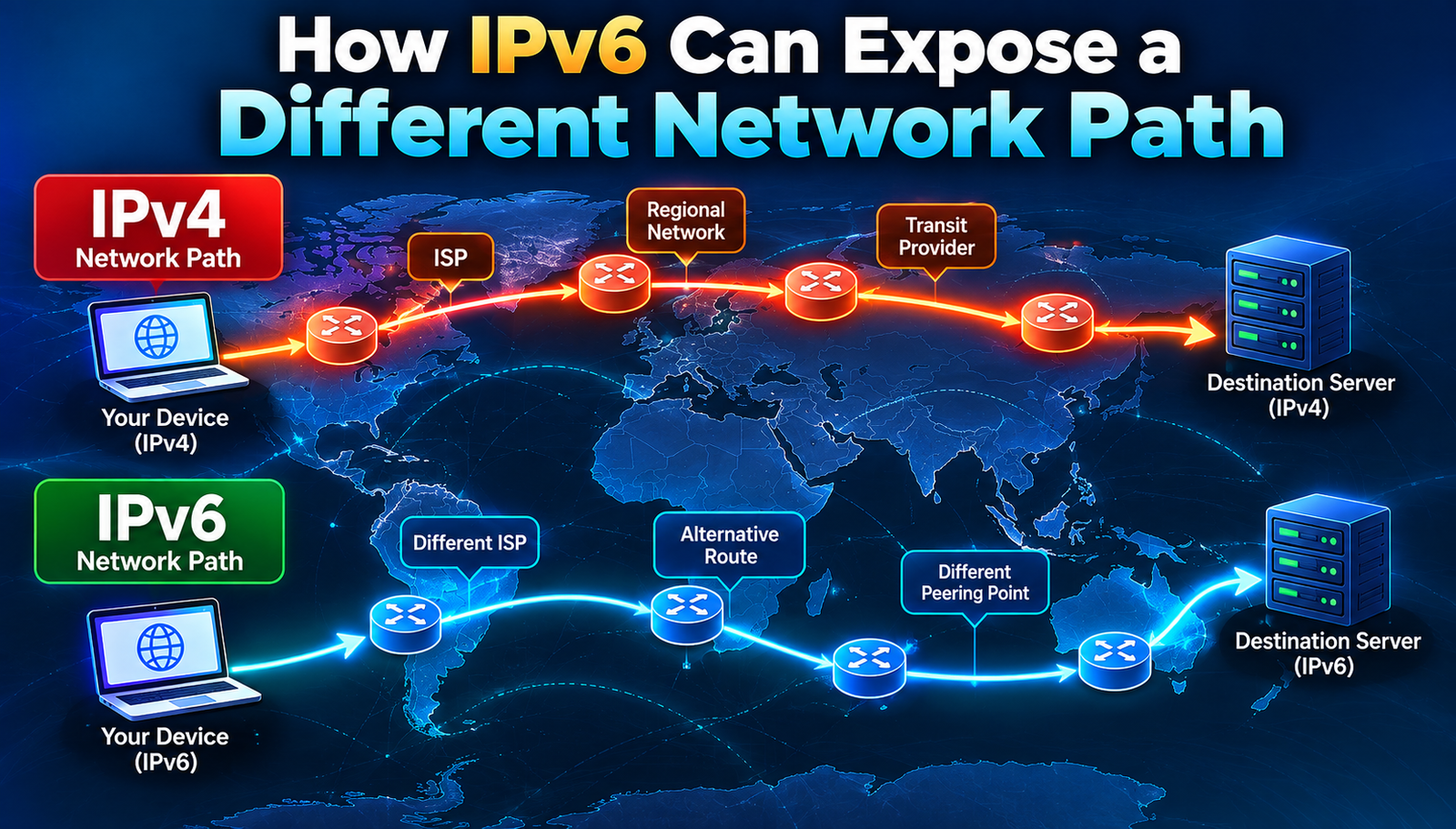
IPv6 can unintentionally expose alternate network routes, creating new security challenges for enterprises.
Statistical insight: In Q3 2024, 42% of Fortune 500 enterprises reported at least one IPv6‑related routing anomaly, compared with 18% for IPv4. The disparity reflects IPv6's larger address space and dual‑stack deployments that often bypass legacy monitoring tools. A recent industry study shows that misconfigured IPv6 prefixes can increase the attack surface by up to 73% because they enable attackers to discover hidden transit paths that IPv4 traffic never traverses. Choosing the correct IPv6 deployment strategy therefore matters not only for performance but also for preserving the confidentiality of internal routing topology.
A Closer Look at IPv6 Path Exposure
Before comparing mitigation techniques, readers must grasp three core concepts: address hierarchy, routing protocols, and dual‑stack interaction. IPv6 addresses are organized into global routing prefixes, subnet identifiers, and interface identifiers. Unlike IPv4's 32‑bit space, the 128‑bit format permits multiple, overlapping prefixes that can be advertised independently on different interfaces. This flexibility enables a single host to announce distinct routes for the same destination via separate ISPs, a behavior that can unintentionally reveal internal network segmentation.
Routing protocols such as BGP, OSPFv3, and IS‑IS propagate these prefixes throughout the internet and internal backbone. When a network runs both IPv4 and IPv6 (dual‑stack), monitoring tools often focus on IPv4 flow logs, leaving IPv6 traffic under‑instrumented. Consequently, a misconfigured IPv6 prefix may be advertised to upstream providers, exposing a path that bypasses the intended security controls. Understanding these dynamics is essential for evaluating any mitigation option.
- Prefix Length Variability
- Why It Matters: Wider prefixes increase the chance of accidental leakage.
- Typical Range: /32–/48 (global) vs /64 (subnet)
- BGP Announcement Frequency
- Why It Matters: Higher frequency indicates dynamic path changes that can be probed.
- Typical Range: Every 5–30 seconds
- Dual-Stack Ratio
- Why It Matters: A higher IPv6 share can amplify exposure risk.
- Typical Range: 30–70% of traffic
- Monitoring Coverage
- Why It Matters: Low IPv6 coverage can leave gaps for attackers.
- Typical Range: 15–40% of flows logged
IPv6 Methods Worth Knowing
1. Strict Prefix Filtering
Strict prefix filtering enforces ACLs on edge routers to block any IPv6 prefix that does not match a pre‑approved list. The approach is common in ISP‑grade deployments and relies on static or dynamically updated prefix tables.
What You Gain:
- Eliminates accidental advertisement of rogue prefixes.
- Reduces attack surface by limiting visible routes.
- Compliance‑friendly for regulated sectors.
What Needs Work:
- Requires continuous prefix inventory management.
- Can cause legitimate traffic loss if filters are overly restrictive.
Best for: environments with a stable set of known prefixes.
2. IPv6‑Specific Network Telemetry (e.g., sFlow‑v6)
Deploying telemetry agents that capture IPv6 flow records provides visibility comparable to IPv4 NetFlow. Vendors have added IPv6 extensions to existing telemetry stacks.
What You Gain:
- Real‑time insight into IPv6 path usage.
- Data for anomaly detection and forensics.
- Integration with existing SIEM pipelines.
What Needs Work:
- Higher processing overhead on routers.
- Telemetry data storage costs rise with 128‑bit address volume.
Best for: organizations seeking parity between IPv4 and IPv6 monitoring.
3. BGPsec Deployment for IPv6
BGPsec adds cryptographic validation to BGP updates, ensuring that advertised IPv6 prefixes cannot be tampered with without detection. Adoption remains limited but is growing in carrier‑grade networks.
What You Gain:
- Authenticates route origin and path attributes.
- Prevents malicious prefix hijacking.
- Provides audit trails for compliance.
What Needs Work:
- Complex key management across multiple routers.
- Performance impact on high‑throughput peering points.
Best for: large ISPs and enterprises with direct peering relationships.
4. IPv6‑Only Segmentation with VRFs
Virtual Routing and Forwarding (VRF) instances isolate IPv6 traffic into separate routing tables. This creates logical partitions that prevent accidental cross‑advertisement between business units.
What You Gain:
- Clear separation of routing policies.
- Granular control over prefix propagation.
- Facilitates zero‑trust network models.
What Needs Work:
- Increased configuration complexity.
- Requires compatible hardware and OS versions.
Best for: multi‑tenant data centers and cloud‑native environments.
5. Automated Prefix Management Platforms
Software‑defined solutions maintain a central inventory of IPv6 prefixes, automatically updating router ACLs and BGP filters via APIs. They often include validation rules to detect overlapping or conflicting prefixes.
What You Gain:
- Reduces manual error rates.
- Scales with rapid address allocation.
- Provides reporting dashboards for governance.
What Needs Work:
- Initial integration effort with legacy equipment.
- Dependence on vendor‑specific APIs.
Best for: enterprises undergoing rapid IPv6 expansion.
- Strict Prefix Filtering
- Best For: Stable prefix environments
- Difficulty: Medium
- Cost: Low-to-Medium
- Speed of Deployment: Fast (days)
- IPv6-Specific Telemetry
- Best For: Parity monitoring needs
- Difficulty: High
- Cost: Medium
- Speed of Deployment: Moderate (weeks)
- BGPsec for IPv6
- Best For: Carrier-grade peering
- Difficulty: High
- Cost: High
- Speed of Deployment: Long (months)
- IPv6-Only VRFs
- Best For: Multi-tenant isolation
- Difficulty: Medium-High
- Cost: Medium
- Speed of Deployment: Moderate (weeks)
- Automated Prefix Management
- Best For: Rapid expansion scenarios
- Difficulty: Medium
- Cost: Medium-High
- Speed of Deployment: Fast to Moderate (days-weeks)
How to Choose the Right One
Decision makers should start with network topology complexity. Environments with a single upstream provider benefit from simple ACLs, whereas multi‑homed networks require cryptographic validation like BGPsec to assure path integrity. Next, assess operational maturity. Teams comfortable with API‑driven workflows will extract greater value from automated prefix platforms, while teams lacking scripting expertise may prefer static filtering.
Another decisive factor is budgetary constraints. Hardware‑based filters have low recurring costs but may need periodic rule updates, whereas telemetry and BGPsec entail ongoing license and processing expenses. Align the cost profile with the organization’s risk appetite; high‑risk sectors such as finance often justify the higher spend on cryptographic routing security.
Regulatory compliance also shapes the choice. PCI‑DSS and HIPAA reference network segmentation and logging requirements that are more easily satisfied by VRF isolation combined with full‑stack telemetry. Conversely, GDPR‑focused organizations may prioritize prefix filtering to limit data exposure across borders.
Finally, consider deployment timeline. If an immediate mitigation is required e.g., after a discovered prefix leak quick‑to‑implement ACLs or an automated prefix tool can be rolled out within days. For long‑term strategic hardening, invest in BGPsec and VRF architectures that provide layered defense.
Balancing these criteria yields a matrix: high complexity + high risk → BGPsec + VRFs; low complexity + limited budget → strict filtering; rapid growth → automated management; need for visibility → telemetry.
Why This Matters to You
Choosing the appropriate IPv6 path‑exposure mitigation directly reduces the likelihood of attackers discovering alternate routes that bypass perimeter defenses. By limiting unintended prefix advertisements, organizations protect sensitive internal traffic from being routed through untrusted upstream networks.
Enhanced visibility through IPv6 telemetry equips security teams with the data needed to detect lateral movement attempts that exploit hidden routes, shortening incident response cycles.
Implementing cryptographic validation such as BGPsec ensures that any route change is verifiable, preventing man‑in‑the‑middle attacks that could otherwise compromise data integrity.
Segmentation via VRFs supports a zero‑trust architecture, making it harder for compromised hosts to reach critical assets even if they obtain a valid IPv6 address. Automated prefix management reduces human error, a leading cause of accidental exposure, and provides audit trails that satisfy auditors and regulators.
Overall, a well‑chosen strategy improves network resilience, lowers operational risk, and aligns the IPv6 deployment with broader security frameworks.
One Last Thing
The core framework for addressing IPv6 path exposure consists of understanding topology, measuring exposure metrics, and selecting a mitigation that matches complexity, cost, and speed requirements. Applying strict filtering, telemetry, BGPsec, VRFs, or automated management alone or in combination provides a layered defense. Organizations that evaluate these factors systematically will maintain control over their routing landscape while reaping IPv6’s performance benefits.
Contact
Missing something?
Feel free to request missing tools or give some feedback using our contact form.
Contact Us