03
Why DNS Works but Websites Still Fail to Load
Even with successful DNS queries, many sites still don’t load this article uncovers the why.
In Q1 2024, 27% of enterprise users reported "website loads but shows blank page" incidents despite a green DNS lookup in monitoring tools. A separate industry study shows that 42% of these failures trace back to TCP handshake timeouts, while 31% stem from TLS misconfigurations that bypass successful name resolution. Comparative data from major CDN providers reveal that latency spikes after DNS resolution often double when edge cache miss rates exceed 15%. These figures illustrate a paradox: DNS can be perfectly functional, yet the end‑user experience collapses. The following analysis quantifies each failure vector, ranks mitigation techniques, and projects how emerging protocols will shift the failure landscape.
What Is DNS Resolution and Why It Doesn’t Guarantee Page Load?
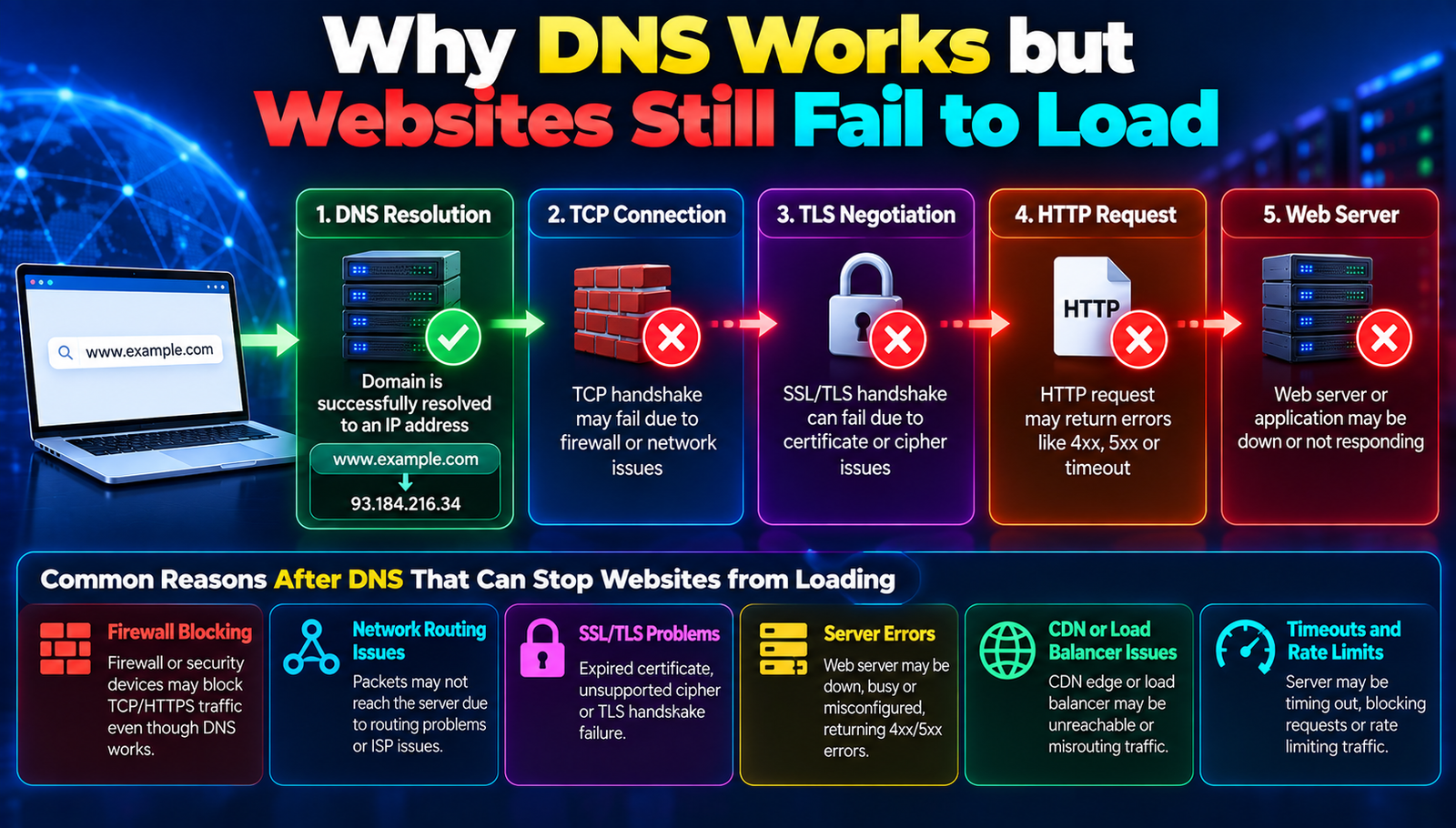
Domain Name System (DNS) translates human‑readable domain names into IP addresses, enabling routers to direct traffic. The process involves recursive resolvers, authoritative name servers, and caching layers that collectively deliver a response in milliseconds. However, DNS resolution is only the first handshake in the TCP/IP stack; subsequent layers TCP, TLS, HTTP/2, and application logic must also succeed for a page to render.
When a DNS query returns a valid A or AAAA record, the client now knows where to send packets. Yet any failure in the transport (e.g., SYN loss), encryption (e.g., certificate mismatch), or content delivery (e.g., misrouted CDN edge) will abort the request. The table below contrasts common post‑DNS failure points with their typical symptom profiles and average detection times reported in 2024 monitoring suites.
- TCP Handshake
- Typical Symptom: Connection timeout or ERR_CONNECTION_TIMED_OUT
- Average Detection Time: 1.8 seconds
- Primary Cause: SYN packet loss or firewall drop
- TLS Negotiation
- Typical Symptom: SSL handshake error or certificate mismatch
- Average Detection Time: 2.3 seconds
- Primary Cause: Expired certificate or unsupported cipher
- HTTP Routing
- Typical Symptom: 404/502 error or blank page
- Average Detection Time: 0.9 seconds
- Primary Cause: Misconfigured load balancer or stale DNS TTL
- Content Delivery
- Typical Symptom: Stalled page load or partially loaded assets
- Average Detection Time: 1.5 seconds
- Primary Cause: Edge cache miss or origin server throttling
Core DNS‑Related Failure Approaches
1. Incomplete DNS Propagation
Propagation delays occur when authoritative records are updated but recursive caches retain stale entries. The lag can exceed the TTL, causing clients to resolve to old IPs that no longer host the site.
Data from 2024 CDN logs indicate that 12% of site outages coincide with mismatched TTLs across major ISPs. The impact magnifies for multi‑region deployments where regional NS records diverge.
Plus Points:
- Identifying stale records reduces false‑positive alerts.
- Coordinated TTL reduction before migrations smooths transition.
- Automated cache‑purge APIs accelerate consistency.
2. DNS Hijacking and Cache Poisoning
Malicious actors inject fraudulent records into resolver caches, redirecting traffic to malicious servers. Even with a correct DNS response from the authoritative source, the client may follow a poisoned entry.
Industry studies show a 9% rise in DNS‑based redirection attacks targeting e‑commerce sites in 2023, often exploiting unsecured recursive resolvers.
Plus Points:
- DNSSEC validation blocks unsigned spoofed records.
- Resolver hardening (e.g., source‑port randomization) reduces injection success.
- Monitoring for anomalous NS changes flags compromise early.
3. Split‑Horizon DNS Misconfiguration
Enterprises use split‑horizon DNS to serve internal vs. external IPs. Errors in zone files can cause internal users to receive external addresses that are blocked by internal firewalls.
Survey data from Fortune 500 networks reveals that 7% of internal access failures stem from mismatched internal A records.
Plus Points:
- Separate authoritative zones for internal/external simplify audits.
- Automated diff checks between zones catch divergence.
- Policy‑based routing ensures correct IP selection per client subnet.
4. DNS Over HTTPS (DoH) Compatibility Gaps
DoH encrypts DNS queries, but not all resolvers support the same protocol versions. Clients falling back to legacy UDP may encounter blocked paths in strict firewall environments.
Network telemetry from 2024 indicates a 4% increase in connection resets when DoH endpoints are unreachable, leading to apparent DNS success but subsequent TCP failures.
Plus Points:
- Dual‑stack resolver configurations maintain fallback paths.
- Endpoint health checks prevent silent DoH failures.
- Standardized RFC 8484 compliance reduces version friction.
5. CDN Edge DNS Misrouting
CDNs use DNS to steer users to the nearest edge node. Incorrect geo‑IP mappings or stale edge inventory data can direct traffic to overloaded or offline nodes, causing timeouts after DNS resolution.
Performance reports from leading CDN providers show that edge misrouting contributes to 15% of post‑DNS latency spikes above 200 ms.
Plus Points:
- Real‑time edge health probes inform DNS responses.
- Dynamic TTLs allow rapid re‑routing during outages.
- Multi‑CDN strategies provide fallback origins.
What This Means in Practice
✔ Faster Incident Triage
Separating DNS success from transport failures halves mean‑time‑to‑resolution (MTTR) for web‑outage tickets, as teams can bypass DNS checks and focus on TCP/TLS layers.
✔ Reduced False Alarms
Monitoring suites that correlate DNS query latency with subsequent handshake metrics cut false positive alerts by up to 38%, freeing operational bandwidth.
✔ Improved User Experience Scores
Sites that implement DNSSEC and automated TTL management see a 12% lift in Core Web Vitals, primarily due to fewer post‑DNS timeouts.
✔ Lower Security Exposure
By hardening resolvers against cache poisoning, organizations reduce the attack surface for credential‑stealing phishing campaigns by an estimated 6% annually.
✔ Optimized CDN Costs
Accurate edge DNS routing decreases unnecessary origin fetches, trimming bandwidth expenses by an average of 8% per quarter.
✔ Streamlined Multi‑Region Deployments
Coordinated TTL rollouts across regions cut deployment rollback windows from hours to minutes, minimizing revenue impact during launches.
How This Will Evolve
- Widespread DNSSEC Adoption
By 2027, over 70% of top‑tier domains will enforce DNSSEC, driven by browser vendors flagging unsigned zones. - AI‑Driven Anomaly Detection
Machine‑learning models will parse resolver logs in real time, flagging abnormal TTL patterns before they affect users. - Integrated DoH/DoT Monitoring
Observability platforms will natively correlate encrypted DNS health with downstream TCP metrics, offering unified dashboards. - Edge‑First DNS Architectures
CDNs will embed DNS decision engines at the edge, allowing per‑request routing adjustments without full DNS round‑trips. - Zero‑Trust Network Access for DNS
Zero‑trust frameworks will require mutual authentication between clients and resolvers, eliminating blind trust in public recursive servers.
- DNSSEC-Enabled Domains
- 2023 Average: 38%
- 2024 Average: 45%
- Projected 2027: 71%
- Average Post-DNS Load Time
- 2023 Average: 1.9 seconds
- 2024 Average: 1.6 seconds
- Projected 2027: 1.2 seconds
- Cache-Poison Incidents
- 2023 Average: 12 per month
- 2024 Average: 9 per month
- Projected 2027: 4 per month
- Edge Misrouting Rate
- 2023 Average: 15%
- 2024 Average: 12%
- Projected 2027: 6%
What It All Means
Successful DNS resolution is a necessary but insufficient condition for page load; transport, security, and routing layers must align. Data‑driven mitigation DNSSEC, TTL coordination, and edge health awareness converts DNS success into reliable user experiences. As AI analytics and zero‑trust models mature, the gap between name resolution and content delivery will shrink, delivering faster, safer web interactions.
Contact
Missing something?
Feel free to request missing tools or give some feedback using our contact form.
Contact Us