04
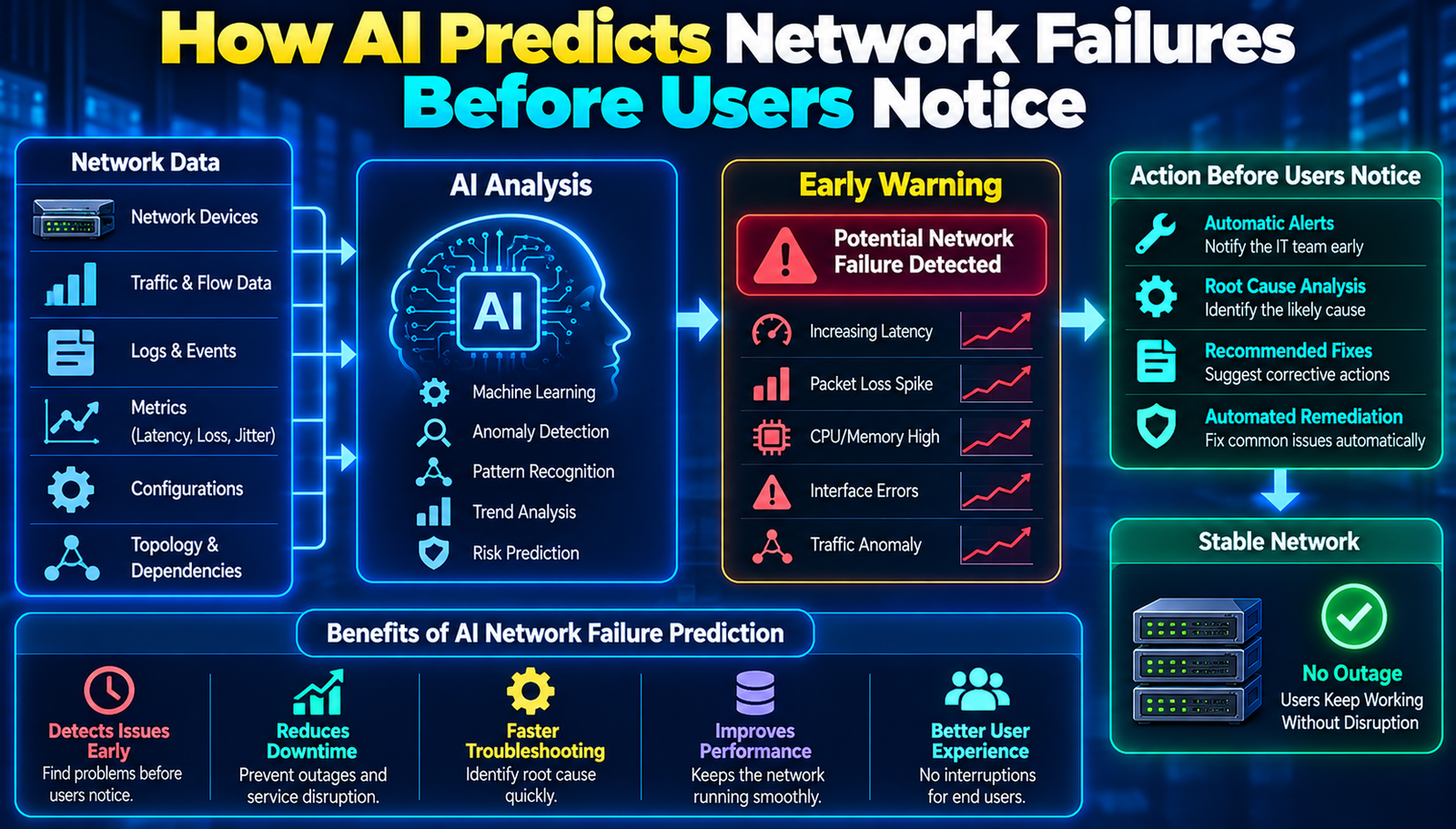
How AI Predicts Network Failures Before Users Notice
AI can now spot network issues before they affect users, offering a proactive shield against outages.
Network reliability is being revolutionized by AI's ability to forecast failures before they impact users. Selecting the right predictive approach matters because it determines how quickly an organization can intervene, preserve service quality, and avoid costly outages. Most enterprises still rely on reactive troubleshooting, which means downtime is discovered only after users complain. By shifting to a proactive, AI‑powered model, businesses gain the ability to see problems on the horizon and act before any disruption reaches the end‑user. This early‑warning capability translates directly into higher customer satisfaction, lower operational expenses, and a competitive edge in a market where uptime is a differentiator.
Understanding Predictive Network Monitoring
Before diving into specific AI tools and methods, it is essential to grasp the fundamentals of predictive network monitoring. At its core, the practice involves collecting vast streams of telemetry packet loss, latency, jitter, device health metrics, and traffic patterns and feeding them into machine‑learning models that learn normal behaviour and flag anomalies that precede failures. Here's the key thing to understand: the models do not simply react to thresholds; they recognize subtle, multivariate patterns that human operators would miss.
Another foundational concept is the distinction between detection and prediction. Detection alerts after a threshold is breached, whereas prediction estimates the likelihood of a breach occurring within a future time window, often 5‑30 minutes ahead. Most people miss this nuance and assume any alert is predictive, leading to over‑confidence in the system. Effective predictive monitoring combines real‑time analytics with historical context, enabling the model to differentiate between transient spikes and genuine precursors to failure.
- Packet Loss Rate
- Why It Matters: Early sign of congestion or hardware degradation
- Typical Source: SNMP, NetFlow
- Ideal Frequency: Every 1–5 seconds
- Latency Variance
- Why It Matters: Fluctuations often precede routing instability
- Typical Source: Active probes, BGP updates
- Ideal Frequency: Every 10–30 seconds
- Interface Error Counters
- Why It Matters: Cumulative errors can indicate hardware wear
- Typical Source: SNMP
- Ideal Frequency: Every 1 minute
- Traffic Flow Distribution
- Why It Matters: Uneven loads can stress specific links
- Typical Source: NetFlow, sFlow
- Ideal Frequency: Every 5–15 seconds
Core Predictive Network Monitoring Approaches
1. Time‑Series Forecasting with ARIMA Models
ARIMA (AutoRegressive Integrated Moving Average) remains a classic statistical technique for forecasting future values based on past observations. In network contexts, it can predict metrics such as bandwidth utilization or packet loss over the next few minutes.
Why It Works:
- Relies on well‑understood mathematical foundations.
- Effective for metrics with clear seasonal patterns.
- Requires relatively modest computational resources.
Challenges:
- Struggles with sudden, non‑linear events like hardware failures.
- Model tuning can be time‑consuming for many metrics.
Best for: environments with stable, periodic traffic where computational overhead must stay low.
2. Supervised Machine Learning with Gradient Boosted Trees
Gradient Boosted Decision Trees (GBDT) such as XGBoost or LightGBM excel at handling heterogeneous features, making them suitable for combining telemetry, configuration data, and external factors like weather.
Why It Works:
- Captures complex, non‑linear relationships.
- Provides feature importance insights for troubleshooting.
- Handles missing data gracefully.
Challenges:
- Requires labelled historical failure events for training.
- Model size can grow large, impacting real‑time inference speed.
Best for: organizations that have accumulated a rich dataset of past incidents and need interpretability.
3. Unsupervised Anomaly Detection with Autoencoders
Autoencoders are neural networks trained to reconstruct normal network behaviour. When reconstruction error spikes, the system flags a potential anomaly that may lead to failure.
Why It Works:
- Does not need labelled failure data.
- Adapts to evolving network baselines.
- Can process high‑dimensional telemetry streams.
Challenges:
- Setting the right error threshold is non‑trivial.
- May produce false positives during legitimate traffic bursts.
Best for: dynamic environments where failures are rare and labelling is costly.
4. Graph‑Based Neural Networks for Topology‑Aware Prediction
Graph Neural Networks (GNN) treat the network as a graph of nodes and edges, learning how failures propagate across the topology. By incorporating link‑level metrics, GNNs can anticipate cascading outages.
Why It Works:
- Explicitly models inter‑node dependencies.
- Excels at predicting multi‑hop failure scenarios.
- Integrates both physical and logical topology data.
Challenges:
- Requires detailed, up‑to‑date topology maps.
- Training complexity is higher than flat models.
Best for: large service provider networks where cascade risk is a primary concern.
5. Reinforcement Learning for Proactive Remediation
Reinforcement Learning (RL) agents learn policies that not only predict failures but also suggest corrective actions, such as rerouting traffic or adjusting QoS settings, before the failure materializes.
Why It Works:
- Combines prediction with automated mitigation.
- Continuously improves through interaction with the live network.
- Can optimize for business‑level objectives like revenue loss.
Challenges:
- Safety concerns during exploration phase.
- Requires a simulation environment or sandbox for safe training.
Best for: enterprises ready to invest in closed‑loop, self‑healing network operations.
- ARIMA Time-Series
- Best For: Stable, periodic traffic
- Difficulty: Low
- Cost: Low
- Speed: Fast (seconds)
- Gradient Boosted Trees
- Best For: Rich historical failure data
- Difficulty: Medium
- Cost: Medium
- Speed: Fast (sub-second)
- Autoencoder Anomaly Detection
- Best For: Highly dynamic environments
- Difficulty: Medium
- Cost: Low to Medium
- Speed: Fast (seconds)
- Graph Neural Networks
- Best For: Large, topology-complex networks
- Difficulty: High
- Cost: High
- Speed: Moderate (seconds to minutes)
- Reinforcement Learning
- Best For: Self-healing, high-value services
- Difficulty: Very High
- Cost: Very High
- Speed: Variable (depends on policy execution)
How to Choose the Right One
Choosing the optimal predictive approach begins with a clear inventory of business objectives. If the primary goal is to reduce mean time to detection for a handful of critical links, a lightweight ARIMA model may suffice. However, when the aim expands to preventing revenue‑impacting cascades across a global backbone, a topology‑aware GNN or RL solution becomes more appropriate.
Next, assess the availability and quality of data. Supervised models such as Gradient Boosted Trees demand a well‑labelled dataset of past failures. In contrast, unsupervised autoencoders thrive on abundant unlabelled telemetry. Organizations lacking extensive failure logs should start with unsupervised or semi‑supervised techniques to avoid the costly labelling effort.
The skill set of the operations team also influences the decision. Teams comfortable with statistical programming can implement ARIMA or GBDT quickly. Those with deep learning expertise may prefer Autoencoders or GNNs. It is essential to match the model complexity to the team's capability to maintain, retrain, and interpret the results.
Budget constraints cannot be ignored. High‑performance GPUs needed for training GNNs or RL agents represent a significant capital expense. Conversely, ARIMA and tree‑based models run comfortably on standard servers, making them attractive for smaller enterprises. Consider both upfront licensing or hardware costs and ongoing operational expenses such as model monitoring.
Finally, evaluate the required prediction horizon and latency. If an organization needs a 5‑minute ahead warning to trigger a manual ticket, slower models are acceptable. For automated traffic engineering that must react within seconds, low‑latency inference from lightweight models or edge‑deployed neural networks is mandatory.
The Impact on Consumers
When predictive AI accurately foresees a network glitch, the first benefit felt by consumers is a smoother experience. Applications load faster, video streams stay uninterrupted, and voice calls remain clear because the network has already mitigated the issue.
Second, confidence in digital services grows. Users are less likely to abandon an online platform when they rarely encounter outages, leading to higher retention and brand loyalty.
Third, service providers can allocate resources more efficiently. By addressing problems before they cascade, they avoid expensive emergency repairs and can schedule maintenance during low‑traffic windows, preserving performance for end‑users.
Fourth, predictive monitoring reduces the need for lengthy incident reports. When the system automatically logs the root cause and the corrective action, customers receive concise, transparent communication rather than vague apologies.
Fifth, AI‑driven prediction enables new service guarantees such as "99.99% uptime" backed by measurable early‑warning metrics, giving enterprises a competitive marketing advantage.
Finally, the overall ecosystem becomes more resilient. As networks learn from each anomaly, they continuously improve, creating a virtuous cycle where each prevented failure makes the next prediction even more accurate, ultimately delivering a more reliable digital environment for everyone.
One Last Thing
In summary, the decision framework hinges on aligning business goals, data readiness, team expertise, budget, and latency requirements with the strengths of each AI approach. Selecting the right predictive method empowers organizations to intervene before users notice any degradation, turning potential outages into invisible, handled events. With the right choice, network reliability transforms from a reactive afterthought into a proactive, data‑driven advantage.
Contact
Missing something?
Feel free to request missing tools or give some feedback using our contact form.
Contact Us